
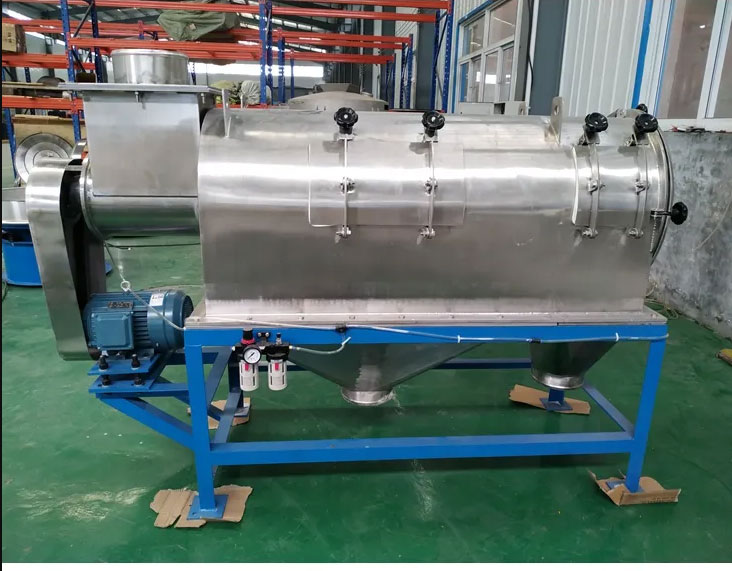
Most people outside of manufacturing have never thought about how powders and granular materials get separated, graded, and cleaned before they end up in a finished product. The flour in a bag, the powder in a pharmaceutical capsule, the pigment in a cosmetic, the recycled plastic pellet going back into production, all of it likely passed across a circular vibrating screen at some point in the process. A Round Sifter Vibrator shows up across a surprisingly wide range of industries, and the specific way each one uses the equipment says a lot about why this particular screening geometry has become so standard. Here’s a look at where it actually gets used and what problem it’s solving in each case.
Food and Beverage Processing
This is probably the largest application category by sheer volume. Flour milling operations use round screeners to remove bran particles, foreign material, and oversized clumps before flour reaches packaging, ensuring consistent texture and protecting against contamination that could trigger a recall. Sugar processing relies on similar separation to achieve uniform granule size, since inconsistent sugar crystal size affects everything from how it dissolves in liquid to how it behaves in baking applications.
Spice and seasoning blend manufacturers use round vibratory screeners constantly, both to achieve consistent particle size across a blend and to catch foreign material, stems, packaging fragments, insect parts, that absolutely cannot make it into a food product. Protein powder and nutritional supplement manufacturers depend on this equipment to break up clumps formed during storage or transport and to ensure the final product mixes smoothly without leaving undissolved chunks in a shaker bottle, which is one of the most common consumer complaints in that category.
Coffee processing facilities use round screeners to grade roasted bean fragments and remove chaff, while beverage powder manufacturers, drink mixes, instant coffee, powdered creamers, rely on consistent screening to prevent the kind of clumping that makes a product look low quality even when the underlying formulation is fine.
Pharmaceutical and Nutraceutical Manufacturing
Particle size distribution in pharmaceutical powders directly affects dissolution rate and bioavailability, which means screening accuracy here carries real regulatory weight rather than just a quality preference. Active pharmaceutical ingredients get screened before blending to ensure consistent particle size across a batch, since variation can affect how evenly a drug compound distributes through a tablet or capsule formulation.
Excipient processing, the inactive ingredients that bind, fill, and stabilize a formulation, depends on the same kind of consistent screening, since excipient particle size affects tablet hardness, dissolution time, and manufacturing consistency. Nutraceutical and vitamin manufacturers face similar requirements, particularly for products combining multiple powdered ingredients where inconsistent particle size in any single component can throw off the blend’s overall uniformity.
Many pharmaceutical-grade round screeners are built with smooth, crevice-free stainless steel surfaces specifically to meet GMP cleaning validation requirements, since residue from a previous batch trapped in hard-to-reach equipment surfaces represents a genuine contamination and cross-contamination risk in this industry.
Chemical Manufacturing
Industrial chemical powders, pigments, catalysts, specialty compounds, often require precise particle size control because particle size directly affects reaction rates, dispersion behavior, and product performance. A pigment manufacturer needs consistent particle size for predictable color development and dispersion in paints or coatings. A catalyst manufacturer needs uniform particle size because surface area, which is directly affected by particle size, governs reaction efficiency.
Fertilizer production uses round screeners to grade granular product into size categories that affect spreading consistency and nutrient release rate, while agricultural chemical manufacturers rely on screening to remove caking and oversized clumps that can clog application equipment in the field.
Cosmetics and Personal Care
Powder cosmetics, foundation, eyeshadow, blush, setting powder, all require fine, consistent particle size for the product to apply smoothly and look professional rather than patchy or grainy. Bath product manufacturers use round screeners for bath salts, bath bombs ingredients, and powdered bath additives, where clumping or inconsistent texture is an immediately visible quality issue to the end consumer.
Talc, mineral powder, and specialty cosmetic ingredient suppliers depend on consistent screening both for product quality and because many cosmetic ingredients have regulatory purity requirements that screening helps verify and maintain through documented, repeatable processing.
Plastics and Recycling
Recycled plastic processing uses round vibratory screeners to separate plastic pellets or regrind by size, removing fines, oversized clumps, and contaminants like metal fragments or unprocessed plastic chunks before the material gets reintroduced into manufacturing. This separation step directly affects the quality and consistency of products made from recycled plastic, which matters increasingly as more manufacturers incorporate recycled content into their supply chains.
Plastic powder coating manufacturers use similar screening to ensure consistent particle size for even coating application, since particle size variation in powder coating directly affects finish quality and coverage consistency on the coated surface.
Mining and Mineral Processing
Smaller-scale mineral processing operations, those not justifying a full industrial screening plant, use round vibratory units to grade crushed ore, separate fine particles from coarser material, and remove contaminants from mineral concentrate. This is particularly common in operations processing specialty minerals or precious metals at smaller volumes, where the value of the material justifies precise screening even at lower throughput.
Why This Equipment Keeps Showing Up Across Such Different Industries
The pattern across all of these applications is fairly consistent: whenever a manufacturing process depends on a powder or granular material behaving predictably, in terms of how it flows, mixes, dissolves, applies, or reacts, particle size consistency turns out to matter more than most people outside the industry would assume. Round vibratory screeners solve that consistency problem efficiently, in a relatively compact footprint, across an unusually wide range of material types.
The other consistent thread is contamination control. Whether it’s a food safety concern, a pharmaceutical purity requirement, or a cosmetic quality standard, the check-screen function that catches foreign material before it reaches the main product stream shows up as a meaningful benefit across nearly every application listed here, not just the food and pharma examples where it’s most obviously critical.
What This Means for Equipment Selection
Given how broadly this equipment gets applied, the specific configuration matters enormously for getting good results in any one application. Mesh size, deck count, motor power, and construction material all need to match the actual material being processed and the regulatory or quality requirements of the specific industry. A unit specified well for food processing might be entirely wrong for chemical manufacturing, even though both applications use fundamentally the same screening principle.
For manufacturers evaluating this equipment for the first time, looking at how similar operations within the same industry have configured their units, and ideally running an actual material trial before committing to a purchase, remains the most reliable way to land on a configuration that performs well over years of production rather than just looking adequate on a spec sheet.
 somiljain
  likeadivaa