
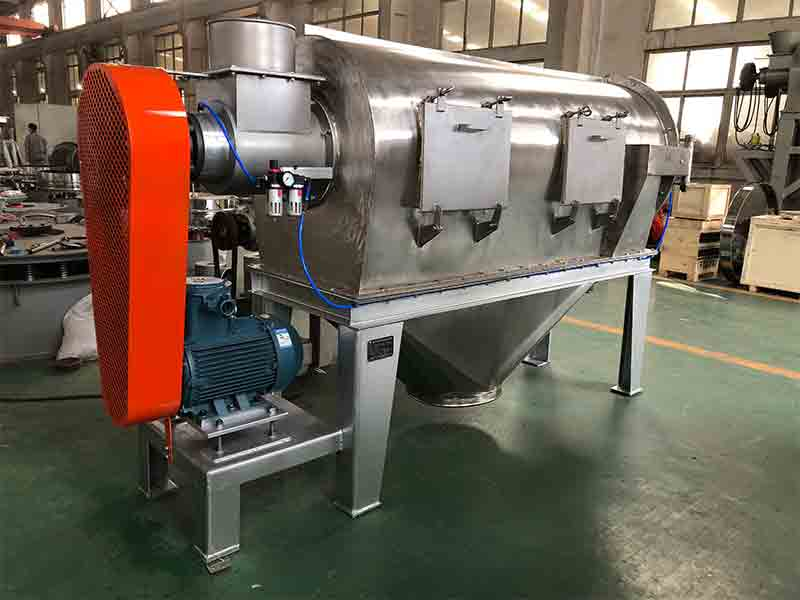
Anyone who’s tried to hand-sieve a batch of fine powder through a mesh screen knows how quickly that process stops being practical past a certain volume. It’s slow, inconsistent between batches, physically tiring, and the separation quality depends heavily on how carefully whoever’s doing it that day happens to shake the screen. A Mini Sifter Vibrator solves this exact problem by replacing manual effort with controlled, repeatable mechanical motion, and for operations handling powders or granules on any regular basis, the difference shows up almost immediately in both output consistency and labor time.
The benefits go well beyond just “faster than doing it by hand,” though. Here’s a closer look at what this equipment actually changes in a production environment, and why it’s become standard equipment across food, pharmaceutical, chemical, and materials processing operations working with smaller batch volumes.
Consistent Particle Separation Every Single Run
Manual sieving produces results that vary from batch to batch and from person to person, because the force, angle, and duration of shaking aren’t standardized. A vibratory unit removes that variability entirely. The vibration frequency and amplitude are mechanically controlled and repeatable, which means the separation result on batch one hundred looks the same as batch one, assuming the material itself hasn’t changed.
This matters enormously in regulated industries. A pharmaceutical manufacturer producing a powder blend for capsule filling needs particle size distribution to fall within a tight specification range, batch after batch, because inconsistent particle size affects dissolution rates, dosing accuracy, and ultimately product efficacy. Consistency that would be nearly impossible to guarantee manually becomes routine with mechanical vibratory separation.
Removing Contamination and Foreign Material Reliably
Beyond sizing product, these units excel at catching what shouldn’t be there. A check screen positioned above the primary separation screen catches foreign material, clumps, packaging debris, or oversized contaminants before they reach the main product stream. In food processing specifically, this functions as a critical control point for contamination prevention, the kind of step that shows up directly in HACCP plans and food safety audits.
Manual screening relies on visual inspection to catch contamination, which is inherently unreliable for small or visually similar foreign particles. Mechanical screening catches anything physically larger than the mesh opening, regardless of whether it’s visually distinguishable from the product, which closes a real gap in contamination control that human inspection alone leaves open.
Significant Time and Labor Savings
A worker manually sieving material is tied to that single task for the entire duration, unable to do anything else productively while it happens. A vibratory sifter, once loaded and running, requires only periodic monitoring, freeing that labor hour for other tasks. For a facility processing several batches a day, this adds up to meaningful labor cost savings over a year, often enough to justify the equipment cost within the first twelve to eighteen months of use.
Throughput also increases substantially. Mechanical vibration moves material across the screen far more efficiently than manual shaking, processing volumes in minutes that might take significantly longer by hand, particularly for fine powders that tend to clump or resist movement without consistent mechanical agitation.
Reduced Product Waste and Rework
Inconsistent manual screening tends to either under-separate, letting oversized particles or clumps through into the final product, or over-separate, rejecting usable product along with genuine waste because the operator erred toward caution. Both outcomes cost money: the first through quality issues or customer complaints, the second through wasted usable material.
Properly calibrated mechanical separation hits the target specification consistently, reducing both types of error. Less product gets incorrectly rejected, and less defective product makes it through to packaging where it would need to be caught later, recalled, or result in a quality complaint that costs far more to resolve than the original material was worth.
Better Handling of Difficult Materials
Some powders and granules are genuinely hard to screen, sticky, fine, prone to clumping under humidity, or with a tendency to compact under their own weight. Manual screening struggles with these materials because the inconsistent force applied by hand often isn’t enough to break up clumps without also forcing oversized material through gaps that shouldn’t pass it.
Adjustable vibration frequency and amplitude on mechanical units allows the operator to tune the separation process specifically for difficult materials, finding the right balance between enough force to break up clumping without compacting fines into the screen mesh. This level of control simply isn’t achievable by hand, regardless of operator skill or experience.
Compact Footprint Without Sacrificing Capability
One of the more underrated benefits of smaller vibratory units specifically is how much separation capability fits into a small physical footprint. Operations with limited floor space, common in artisanal food production, smaller pharmaceutical compounding facilities, or labs running frequent small-batch trials, get access to the same separation principles used in full industrial screening lines, scaled appropriately for their actual production volume.
This also means lower upfront capital cost and lower power consumption compared to full-scale industrial screening equipment, making mechanical separation accessible to smaller operations that wouldn’t be able to justify a larger system’s cost or space requirements.
Easier Compliance and Documentation
Regulated industries increasingly require documented evidence of process control, not just a finished product that happens to meet specification. Mechanical vibratory separation, with its consistent and adjustable parameters, is far easier to document and validate than a manual process that depends on individual operator technique. Settings can be recorded, replicated, and audited in a way that “an experienced worker shook it until it looked right” simply cannot be.
For facilities operating under GMP, HACCP, or similar quality frameworks, this documentation advantage often matters as much as the physical separation benefit itself, since auditors and regulators are looking for evidence of controlled, repeatable processes as much as they’re looking at the final product.
Versatility Across Materials and Applications
A single well-specified unit, particularly one with interchangeable screens, can handle a wide range of materials: flour and food powders, pharmaceutical excipients, pigments and cosmetic powders, chemical compounds, even crushed or granulated material in recycling and small-scale mineral processing. This versatility means a facility processing multiple products doesn’t necessarily need separate dedicated equipment for each one, which improves the return on the initial equipment investment considerably.
Where the Benefits Actually Add Up
Individually, consistent separation, contamination control, labor savings, reduced waste, and compliance documentation each represent a meaningful improvement over manual sieving. Together, they tend to compound: less wasted material means lower raw material costs, fewer quality complaints mean less rework and fewer customer relationship issues, and labor freed from manual screening means that time goes toward higher-value work elsewhere in the operation.
For any facility still relying on manual sieving for powder or granule separation at meaningful volume, the question worth asking isn’t really whether mechanical separation would help. It almost always does. The more useful question is which specific configuration, mesh size, motor power, deck count, fits the actual material and volume being processed, since getting that match right is what determines whether the equipment delivers on these benefits consistently over years of use rather than just in the first few months.
 likeadivaa
 ukrepresent