
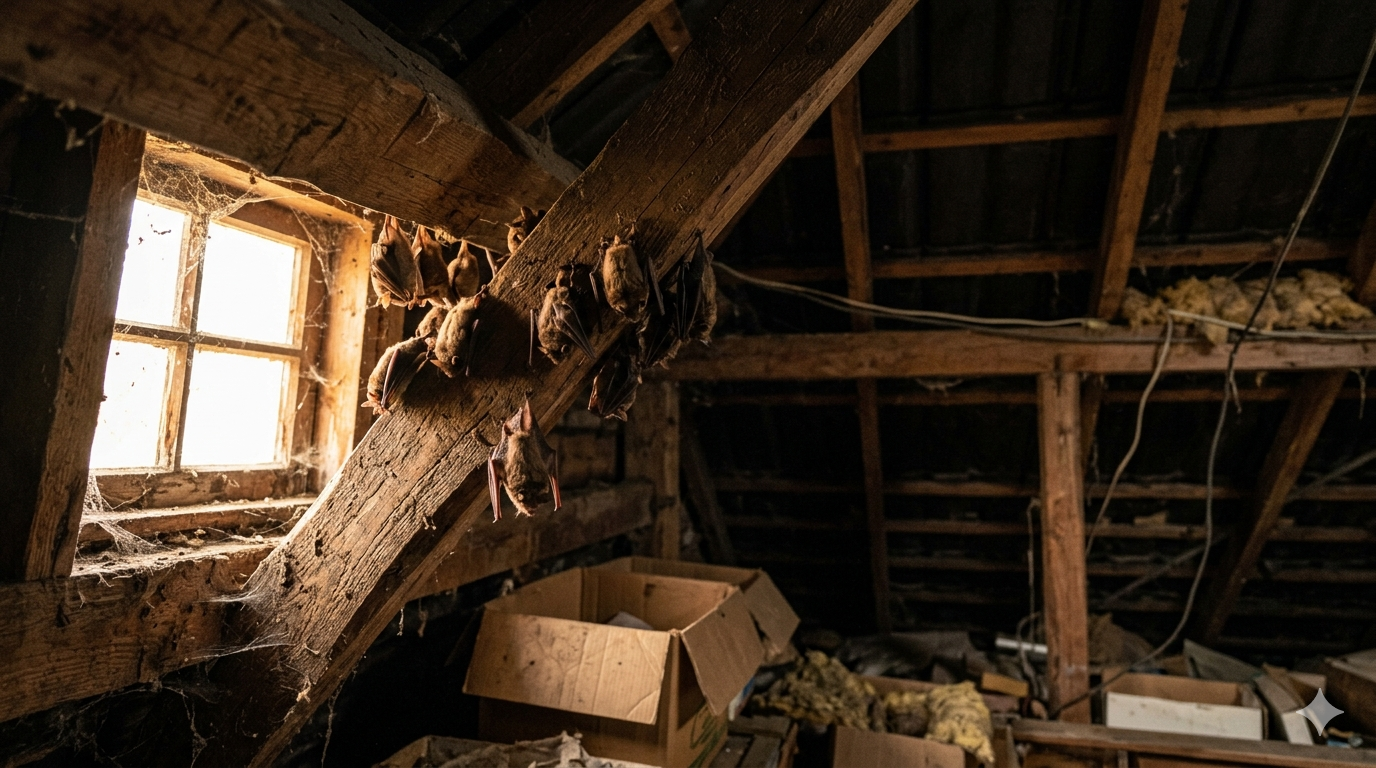
Bats in Your Attic? Here’s What to Do
Bats are great for the ecosystem — but not inside your home. Here’s how to spot the problem early and deal with it the right way.
Most homeowners don’t realize they have a bat problem until it’s grown into a full colony. Bats are nocturnal, quiet, and good at hiding. But the signs are there if you know what to look for.
Warning signs
How to know if bats are in your attic
These are the most common red flags — look for more than one before drawing conclusions.
🔊
Scratching at night
Light fluttering or squeaking sounds from the ceiling around dusk
💧
Ammonia smell
A strong, pungent odor — bats’ urine soaks into wood and insulation over time
⚫
Dark droppings
Bat guano is small, dark, and crumbly — often found near vents or window sills
🟤
Greasy stains
Oily smudge marks around tiny entry holes — bats leave residue as they squeeze in
🦇
Bats at dusk
Seeing one or more flying near your roofline at sunset is a strong indicator
🕳️
Small gaps in soffits
Bats can squeeze through a hole the size of a dime — check eaves, vents, and flashing
Bat guano can cause histoplasmosis — a respiratory disease caused by inhaling fungal spores. Never vacuum or dry-sweep it without proper protective gear.
Removal options
What are your options?
There’s really only one effective, legal approach: exclusion. This means letting bats exit on their own through a one-way device, then sealing all entry points so they can’t return.
Bat repellents, mothballs, and essential oils don’t work. There are also no registered pesticides for bats — and in most regions, killing bats is illegal.
1
Inspection: A professional identifies all entry points, the size of the colony, and the time of year (maternity season restrictions apply May–August).
2
Install exclusion devices: One-way tubes or netting are placed at active entry points, letting bats exit but not return.
3
Seal all other gaps: Every crack, vent gap, and opening is sealed with caulk, foam, or hardware cloth — typically takes 3–7 days.
4
Remove the devices: Once the colony has vacated, exclusion devices are removed and the final entry point is sealed.
5
Clean and sanitize: Guano is removed and the area disinfected to eliminate odors, pathogens, and — importantly — to prevent bats from returning by smell.
Important don’ts
Mistakes to avoid
- Don’t seal entry points while bats are still inside — they’ll find their way into your living space
- Don’t attempt removal during maternity season (May–August) — pups can’t fly yet
- Don’t handle bats with bare hands — even a small bite can require rabies testing
- Don’t disturb hibernating bats in winter — wait for warmer months
- Don’t skip the cleanup — bats can return by following the scent of old guano
Think you have bats?
Don’t wait — a small colony becomes a bigger problem fast. Get a professional inspection to confirm the issue and start the right removal process.
Frequently asked questions
How long does bat removal take?
Most bat removal projects take 1–2 weeks from start to finish. This gives bats enough time to exit through the exclusion devices. Sealing and cleanup follow once the attic is confirmed clear.
Can I remove bats myself?
It’s not recommended. Beyond health risks, many bat species are legally protected and removal during maternity season can result in penalties. Professionals know local laws, have protective equipment, and can seal every entry point properly.
Will bats come back after removal?
They can — bats live up to 30 years and remember their roosts. Full sanitization is critical because bats track old scent trails. Proper sealing of every entry point after exclusion is the key to a permanent fix.
What time of year is best for bat removal?
Spring (before May) or fall are the best windows. Removal is restricted during maternity season (May–mid August) when pups can’t fly. Winter removal is also tricky because bats may be hibernating.
Does homeowner’s insurance cover bat removal?
Most standard policies don’t cover pest removal itself, but some will cover damage to insulation or structure caused by guano accumulation. It’s worth contacting your insurer — many professionals can help prepare insurance bids for insulation replacement.
How much does professional bat removal cost?
Costs typically range from $200 to $550+ depending on your location, the size of the colony, and the extent of damage. Larger infestations with guano cleanup and insulation replacement will cost more.
 taraloc543
  shamshaider
  BillionaireStudio