
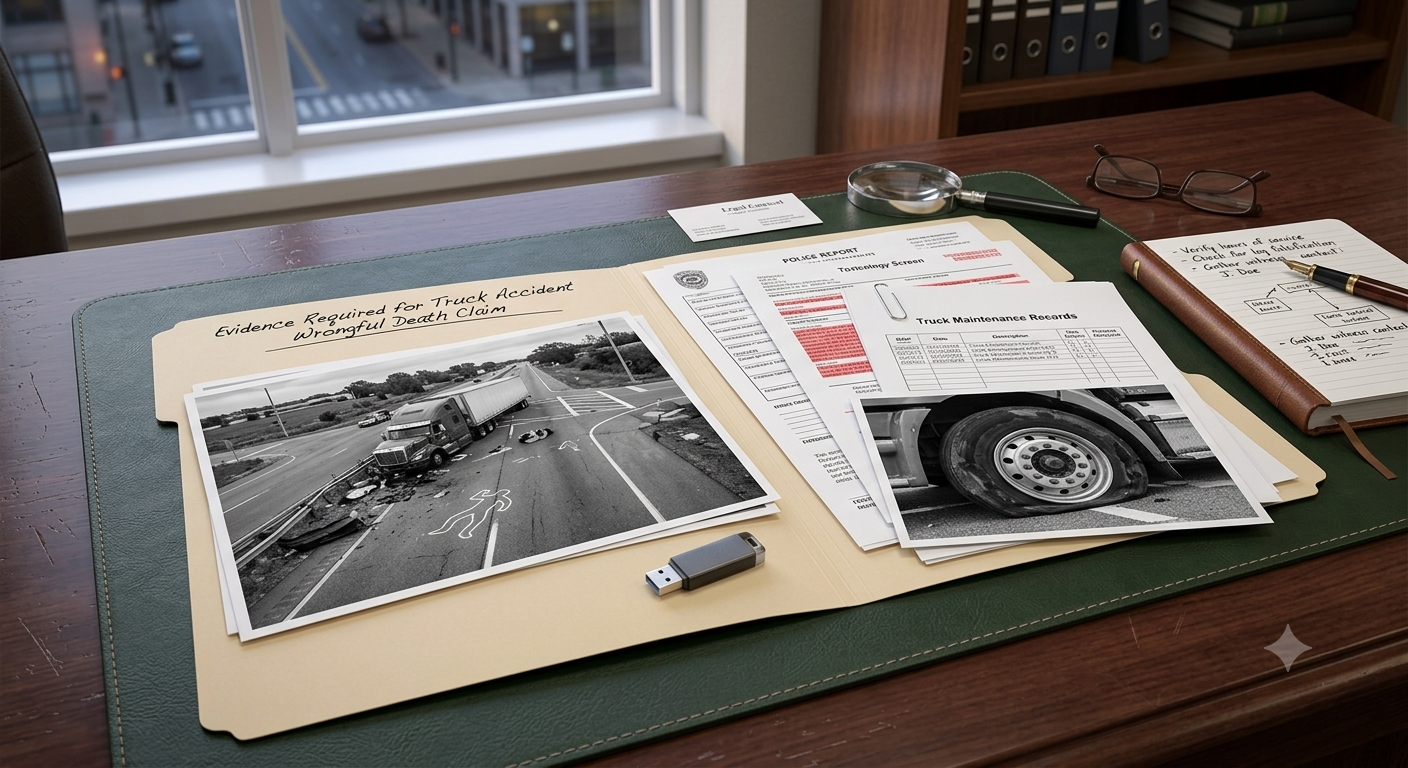
Losing a loved one in a fatal truck accident is a devastating experience. In addition to emotional grief, surviving family members often face financial hardship, unanswered questions, and the challenge of holding negligent parties accountable. When pursuing a wrongful death claim, evidence becomes one of the most important factors in proving liability and recovering compensation.
Building a strong case requires a thorough investigation and the preservation of critical records. Families who work with an experienced wrongful death lawyer can often uncover evidence that demonstrates exactly how the accident occurred and who should be held responsible.
Why Evidence Matters in a Wrongful Death Claim
A wrongful death claim must establish that another party’s negligence or misconduct caused the fatal truck accident. Insurance companies and trucking companies rarely accept responsibility without substantial proof.
Strong evidence helps demonstrate:
- How the accident occurred
- Who was at fault
- Whether federal safety regulations were violated
- The financial impact on surviving family members
- The full extent of damages suffered
Without sufficient evidence, recovering fair compensation can become significantly more difficult.
Police Accident Reports
One of the first pieces of evidence collected after a fatal truck accident is the official police report.
Law enforcement officers typically document:
- Date and location of the crash
- Road and weather conditions
- Vehicle positions
- Preliminary findings
- Driver information
- Witness details
- Traffic violations
Although the police report may not determine final liability, it often serves as an important starting point for a wrongful death investigation.
Black Box Data
Commercial trucks are often equipped with Event Data Recorders (EDRs), commonly known as black boxes.
These devices can record valuable information before and during a collision, including:
- Vehicle speed
- Brake usage
- Steering activity
- Engine performance
- Sudden acceleration or deceleration
- Driver actions before impact
Black box evidence can provide objective data that helps accident reconstruction experts understand what happened in the moments leading up to the crash.
Because trucking companies may have access to this information immediately after an accident, preserving black box data quickly is essential.
Electronic Logging Device (ELD) Records
Federal Motor Carrier Safety Administration (FMCSA) regulations require most commercial truck drivers to use Electronic Logging Devices.
ELDs track:
- Driving hours
- Rest breaks
- Duty status
- Route information
These records can reveal whether a driver violated Hours of Service regulations.
Driver fatigue is a leading cause of fatal truck accidents. If records show a driver exceeded legal driving limits, that evidence may significantly strengthen a wrongful death claim.
Driver Qualification and Employment Records
A trucking company’s hiring and supervision practices often become a focus during a wrongful death investigation.
Important records may include:
Commercial Driver’s License Information
Investigators review whether the driver possessed the proper qualifications and endorsements.
Driving History
Previous traffic violations, accidents, or safety violations may reveal patterns of risky behavior.
Training Records
Companies must properly train drivers to operate commercial vehicles safely.
Drug and Alcohol Testing Results
Federal regulations require trucking companies to conduct certain drug and alcohol screenings.
Evidence of poor hiring practices or inadequate training may help establish trucking company negligence.
Maintenance and Inspection Records
Commercial trucks require regular inspections and maintenance to remain safe on the road.
Maintenance records can reveal whether a trucking company ignored known safety issues.
Common concerns include:
- Brake failures
- Tire defects
- Steering problems
- Lighting issues
- Mechanical malfunctions
If neglected maintenance contributed to the fatal accident, the trucking company or maintenance contractor may share liability.
Photographs and Video Evidence
Visual evidence often plays a critical role in wrongful death truck accident cases.
Photographs may document:
- Vehicle damage
- Road conditions
- Debris patterns
- Skid marks
- Traffic signs
- Weather conditions
Video evidence may come from:
- Dash cameras
- Traffic cameras
- Business surveillance systems
- Nearby security cameras
These images can help reconstruct the accident and support witness testimony.
Witness Statements
Eyewitness accounts often provide valuable information that may not appear in official reports.
Witnesses may describe:
- Vehicle speed
- Driver behavior
- Lane changes
- Traffic conditions
- Signs of distracted or reckless driving
Because memories fade over time, obtaining witness statements as soon as possible after the accident is important.
Accident Reconstruction Analysis
Fatal truck accident claims frequently involve accident reconstruction experts.
These professionals analyze:
- Physical evidence
- Vehicle damage
- Black box data
- Roadway conditions
- Witness statements
Using scientific methods, reconstruction experts can determine how the crash likely occurred and whether negligence played a role.
Their findings often become powerful evidence during settlement negotiations or trial.
Cell Phone and Communication Records
Distracted driving is a common factor in serious trucking accidents.
Investigators may review:
- Cell phone records
- Text messages
- Dispatch communications
- GPS activity
- Electronic communication logs
Evidence showing a driver was texting, talking on the phone, or interacting with devices before the crash may establish negligence.
Medical Records and Death Documentation
Families must also prove that the truck accident directly caused the victim’s death.
Important documents include:
Medical Records
These records connect accident-related injuries to the victim’s treatment and eventual passing.
Death Certificate
The death certificate officially identifies the cause and manner of death.
Medical Expert Opinions
Doctors and medical experts may provide testimony linking the injuries sustained in the crash to the fatal outcome.
This evidence is essential when establishing causation in a wrongful death claim.
Financial Evidence for Damages
A wrongful death claim must also demonstrate the financial impact of the loss.
Relevant evidence may include:
- Employment records
- Tax returns
- Income statements
- Benefits information
- Future earning projections
These documents help calculate compensation for lost financial support and future income.
How Evidence Helps Identify Liable Parties
Truck accident wrongful death claims often involve multiple responsible parties.
Evidence may reveal negligence by:
- The truck driver
- The trucking company
- Cargo loading companies
- Maintenance contractors
- Vehicle manufacturers
An experienced 18 wheeler truck accident lawyer can analyze the evidence and identify every potentially liable party.
In complex cases involving catastrophic losses, families often seek guidance from the best 18 wheeler accident lawyer available to ensure no critical evidence is overlooked. Whether working with a lawyer for 18 wheeler accident claims or an 18 wheeler accident lawyer Texas families trust, preserving evidence early can significantly impact the outcome of the case. A knowledgeable Texas truck accident lawyer can also issue preservation letters to prevent important records from being destroyed.
Conclusion
Evidence is the foundation of every successful truck accident wrongful death claim. Police reports, black box data, ELD records, maintenance logs, witness statements, medical documentation, and expert analysis all help establish liability and support compensation claims.
Because trucking companies and insurers often begin building their defense immediately after a fatal crash, families should act quickly to preserve critical evidence. A comprehensive investigation can help uncover the truth, identify responsible parties, and provide the strongest possible foundation for pursuing justice after the loss of a loved one.
 visionlosslawyer
  RavikrJha
  jezzylin