
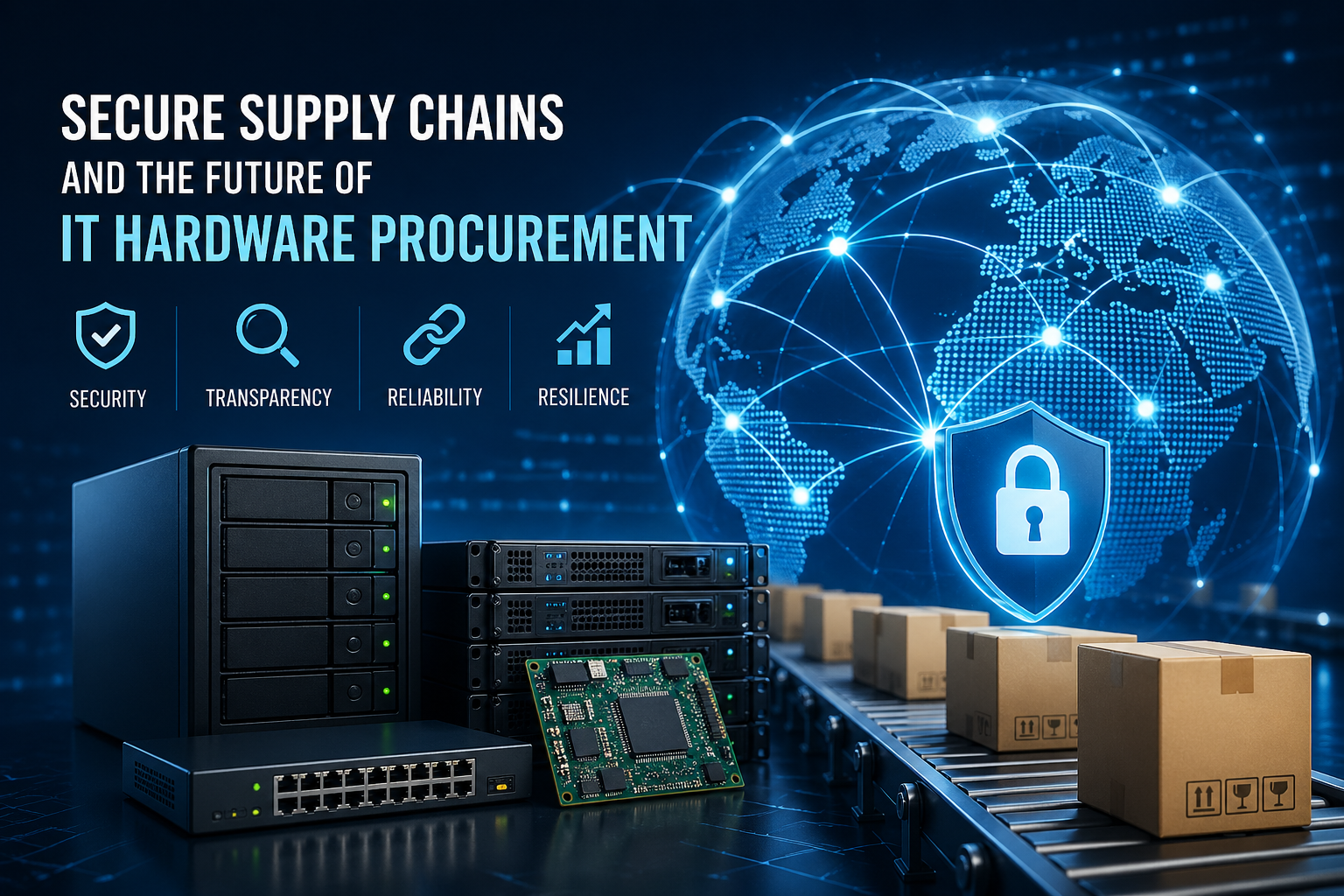
In today’s hyperconnected digital economy, organizations depend heavily on global ecosystems that deliver everything from semiconductors to enterprise servers. However, these systems are becoming increasingly fragile due to geopolitical instability, cyber risks, and resource shortages. As a result, businesses are being forced to rethink how they design resilience into their operations while still maintaining cost efficiency and speed.
At the center of this transformation lies it hardware procurement, which is no longer just a purchasing function but a strategic discipline tied directly to security, continuity, and long-term competitiveness. Every decision in sourcing servers, storage systems, networking devices, and components now carries implications for risk exposure and operational stability.
Consequently, organizations are shifting their focus from purely cost-driven purchasing toward building secure, transparent, and diversified procurement ecosystems that can withstand global disruptions.
The Growing Importance of Secure Supply Chains in IT Hardware Procurement
Modern enterprises rely on deeply interconnected global networks to source IT hardware components. These systems span multiple countries, suppliers, and logistics providers, making them highly efficient but also increasingly vulnerable. In recent years, disruptions caused by geopolitical tensions and material shortages have shown how fragile global dependencies can be.
At the same time, cyber threats targeting hardware and software vendors have added a new layer of complexity. A single compromised supplier can potentially affect thousands of downstream organizations. This reality has made secure sourcing a top priority in IT decision-making.
As a result, Supply Chains are no longer viewed as static pipelines but as dynamic ecosystems that require constant monitoring, validation, and risk assessment. Enterprises are now expected to understand not only who their direct suppliers are but also the deeper tiers of vendors supporting those suppliers.
How Supply Chains Are Reshaping IT Hardware Strategy
The traditional approach to IT procurement focused primarily on price optimization and vendor relationships. However, that model is no longer sufficient in an era defined by volatility and digital dependency.
Today, organizations are redesigning their procurement strategies around resilience. This includes diversifying suppliers, investing in regional sourcing hubs, and adopting real-time monitoring systems to track component availability.
Another key shift is the integration of cybersecurity into procurement decisions. Hardware authenticity, firmware integrity, and supply chain transparency are now critical evaluation factors. Even enterprise buyers are beginning to demand greater visibility into where and how components are manufactured.
In this evolving landscape, Supply Chains have become strategic assets rather than operational back-end systems. Companies that fail to modernize their procurement approach risk facing delays, cost spikes, and security vulnerabilities.
Cybersecurity Risks Embedded in Supply Chains
One of the most critical concerns affecting IT hardware procurement today is cybersecurity. Attackers increasingly target upstream vendors because compromising a single supplier can provide access to multiple downstream organizations.
For example, firmware tampering, counterfeit components, and compromised logistics channels are becoming more sophisticated. These risks are difficult to detect because they often occur before hardware even reaches the enterprise environment.
Furthermore, research shows that organizations struggle to maintain full visibility over their extended vendor ecosystems, especially across multiple tiers of subcontractors. This lack of transparency creates blind spots that attackers can exploit.
As a result, strengthening supply chain security has become a core requirement for procurement teams. This includes implementing stricter vendor verification, continuous auditing, and integrating cybersecurity assessments into procurement workflows.
Supply Chains and the Shift Toward Resilient Procurement Models
Global disruptions in recent years have demonstrated that efficiency alone is not enough. Businesses that relied heavily on single-source suppliers or just-in-time inventory models experienced significant delays when disruptions occurred.
In response, enterprises are adopting more resilient procurement frameworks. These include multi-sourcing strategies, regional diversification, and buffer stock planning for critical components.
Additionally, advanced analytics and AI-driven forecasting tools are helping organizations predict shortages and optimize procurement timing. These technologies allow businesses to simulate risk scenarios and prepare alternative sourcing strategies in advance.
This shift marks a fundamental change in how Supply Chains are managed, moving from reactive problem-solving to proactive risk prevention.
The Role of Technology in Transforming Supply Chains
Digital transformation is playing a major role in reshaping procurement processes. Technologies such as blockchain, AI, and IoT are improving transparency, traceability, and efficiency across global supply networks.
Blockchain, for instance, enables immutable tracking of components from manufacturing to delivery, reducing the risk of counterfeit hardware entering the ecosystem. Similarly, AI-based systems can analyze global demand trends and predict potential bottlenecks before they occur.
These innovations are helping organizations gain real-time visibility into their supply networks, allowing for faster decision-making and improved risk management.
At the same time, automation is streamlining procurement workflows, reducing manual errors, and increasing compliance with internal and regulatory standards.
Ultimately, these advancements are strengthening Supply Chains by making them more intelligent, adaptive, and secure.
Challenges Facing the Future of IT Hardware Procurement
Despite technological progress, several challenges continue to affect global procurement systems. Geopolitical instability remains one of the most significant risks, as trade restrictions and regional conflicts can quickly disrupt component availability.
In addition, the rising demand for advanced computing infrastructure, particularly for AI and data centers, is placing enormous pressure on semiconductor and hardware supply networks. This demand imbalance often leads to price volatility and extended lead times.
Environmental factors and sustainability regulations are also influencing procurement decisions. Companies are now expected to source responsibly, reduce carbon footprints, and comply with stricter global standards.
These challenges highlight the need for stronger coordination across Supply Chains, ensuring that procurement strategies remain both sustainable and resilient in the long term.
The Future Outlook of Supply Chains in IT Hardware Procurement
Looking ahead, the future of IT hardware procurement will be defined by adaptability, intelligence, and security. Organizations will increasingly rely on predictive analytics to anticipate disruptions and make informed sourcing decisions.
We can also expect deeper integration between procurement and cybersecurity teams, ensuring that risk management becomes a shared responsibility rather than a siloed function.
Furthermore, supplier ecosystems will continue to evolve toward greater transparency, driven by regulatory pressure and market demand for accountability.
As these changes unfold, Supply Chains will become even more central to business strategy, influencing not just procurement but also innovation, scalability, and competitive advantage.
Conclusion
In conclusion, the evolution of global procurement is reshaping how organizations approach IT infrastructure and hardware sourcing. What was once a cost-driven function has now become a strategic pillar of enterprise resilience.
By prioritizing security, transparency, and diversification, businesses can reduce risk and ensure continuity even in uncertain environments. At the same time, technological advancements are enabling smarter and more predictive procurement systems.
Ultimately, the organizations that succeed in the coming years will be those that treat Supply Chains as critical infrastructure rather than operational support systems. In a world defined by constant disruption, building resilient procurement ecosystems is no longer optional but essential for long-term success.
 Lavishcars
  taraloc543