
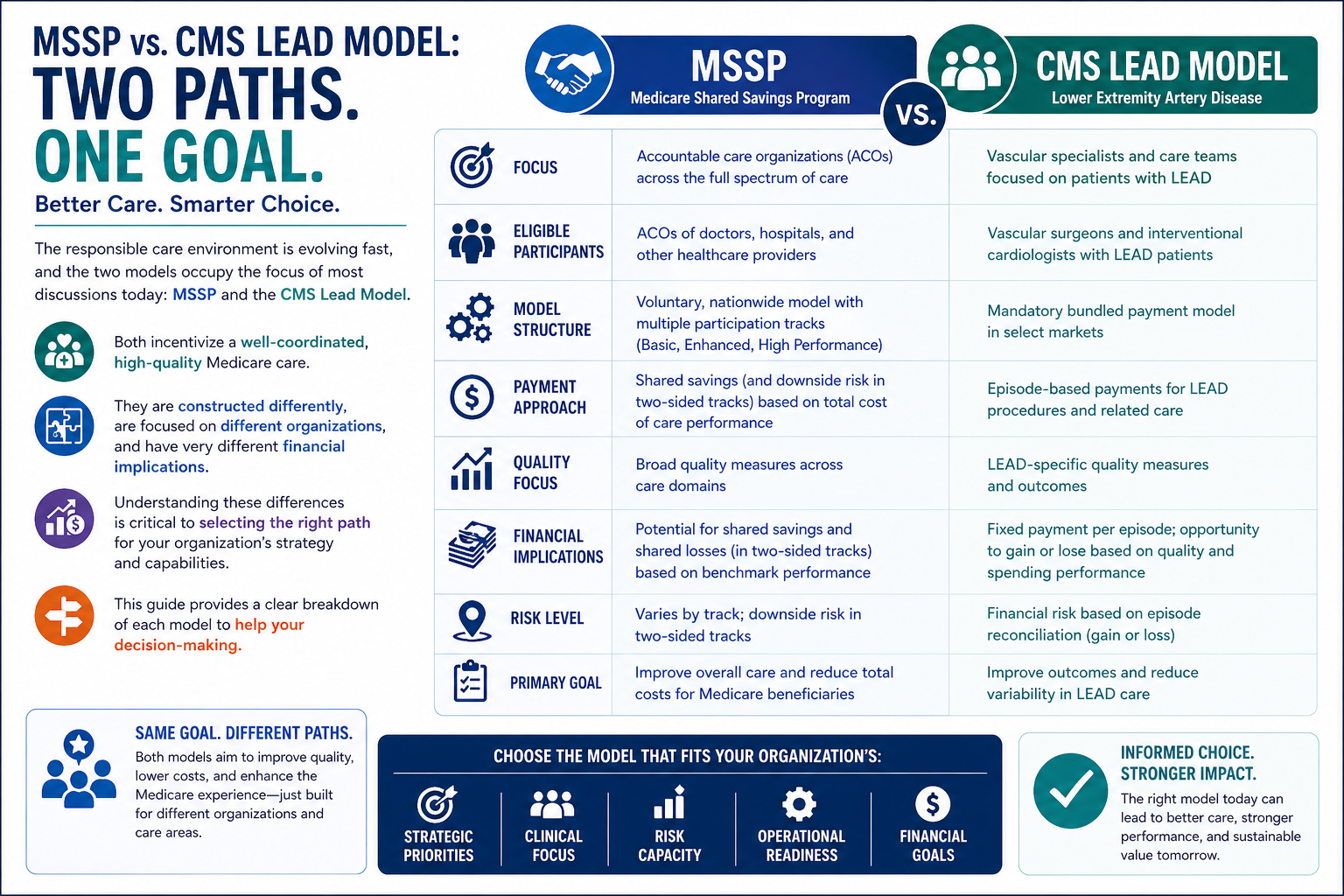
The responsible care environment is evolving fast, and the two models occupy the focus of most discussions today: MSSP and the CMS Lead Model. Both incentivize a well-coordinated, high-quality Medicare care. They are constructed differently, are focused on different organizations, and have very different financial implications. This guide provides a clear breakdown of each model to help your decision-making.
Understanding The Two Models
These programs are not interchangeable. Each reflects a different philosophy for how value-based care operates and whom it serves.
What is MSSP?
MSSP (Medicare Shared Savings Program) has remained the major ACO framework used by CMS since the year 2012. An ACO consists of providers who organize care for assigned Medicare beneficiaries and share any savings achieved. It has two major programs: BASIC (graduated risk, suitable for newer ACOs) and ENHANCED (higher risk and reward, experienced organizations).
What is the CMS Lead Model?
The CMS LEAD Model Long-term Enhanced ACO Design is a 10-year voluntary accountable care program, recently launched on January 1, 2026. It substitutes ACO REACH and specifically targets the frustrations that providers reported with the past models, specifically in the instability of benchmarks and integration barriers of specialists.
How They Actually Differ
Both models aim to improve care while reducing costs, but their mechanics differ. Understanding these differences simplifies the decision.
Benchmark Stability
This is the single biggest structural difference between the two.
MSSP resets benchmarks every few years. The stronger your performance, the tougher your next benchmark becomes, a pattern known as the “ratchet effect” that has pushed high performers out of the program altogether.
LEAD locks benchmarks for a full decade. Efficiency gains do not affect your benchmarks in year five, making the LEAD model attractive for consistently high-performing organizations.
Risk Tracks
- MSSP BASIC: Graduated shared savings, limited downside, suited for organizations newer to ACO participation
- MSSP ENHANCED: Full two-sided risk, higher savings potential
- LEAD Professional: Up to 50% shared savings, up to 50% loss of responsibility
- LEAD Global: Up to 100% shared savings, up to 100% loss responsibility for financially mature organizations ready for full accountability
Who Does Each Model Serve Best
MSSP is suitable if you:
- Are new to value-based care or establishing your ACO foundation
- Prefer a shorter initial commitment with room to scale
- Operate a straightforward provider network without complex specialist arrangements”
LEAD works well if you:
- Are a high performer affected by benchmark resets
- Serve rural, dually eligible, or underserved populations
- Need improved infrastructure for specialist integration
- Previously participated in ACO REACH and seek continuity with stronger support
What LEAD Introduces That Changes the Game
LEAD is more than a renamed ACO REACH. It introduces structural improvements that prior programs did not fully provide.
- CARA (CMS Administered Risk Arrangements) provides a framework for administratively manageable episode-based risk sharing between ACOs and specialists, addressing a long-standing challenge for providers.
- Infrastructure support payments for small practices, rural providers, and community health centers, separate from performance reconciliation
- Expanded benefit enhancements, including Part D premium buydown by 2029 and broader Medical Nutrition Therapy coverage
- Medicaid collaboration pathway: CMS plans to align two state Medicaid programs with LEAD ACOs starting in 2026
The Decision Checklist
Before you choose, run through these honestly:
- Has benchmark re-basing hurt your savings trajectory under MSSP?
- Do you have the financial reserves to absorb losses under a two-sided risk model?
- Are you serving populations LEAD specifically supports, rural, low-income, dually eligible?
- Is your specialist network ready for episode-based arrangements via CARA?
- Can your technology infrastructure handle a decade-long performance commitment?
If you answered yes to most of these, LEAD deserves serious consideration. If you’re still building your value-based foundation, MSSP remains a solid, proven path.
Wrap Up
The right model is not the most advanced one; it’s the one your organization is actually built to succeed in. MSSP offers a tested, flexible entry into accountable care. The CMS Lead Model offers something new: long-term stability, better specialist tools, and infrastructure support designed for the providers’ traditional ACO models left behind.
Take the Next Step With the Right Technology Partner
Persivia offers a purpose-built digital health platform for ACOs, payers, and health systems navigating value-based care. From risk stratification and care management to quality reporting and population health analytics, Persivia equips your organization to succeed with either MSSP or the CMS LEAD Model.
 glennprior
 jezzylin