
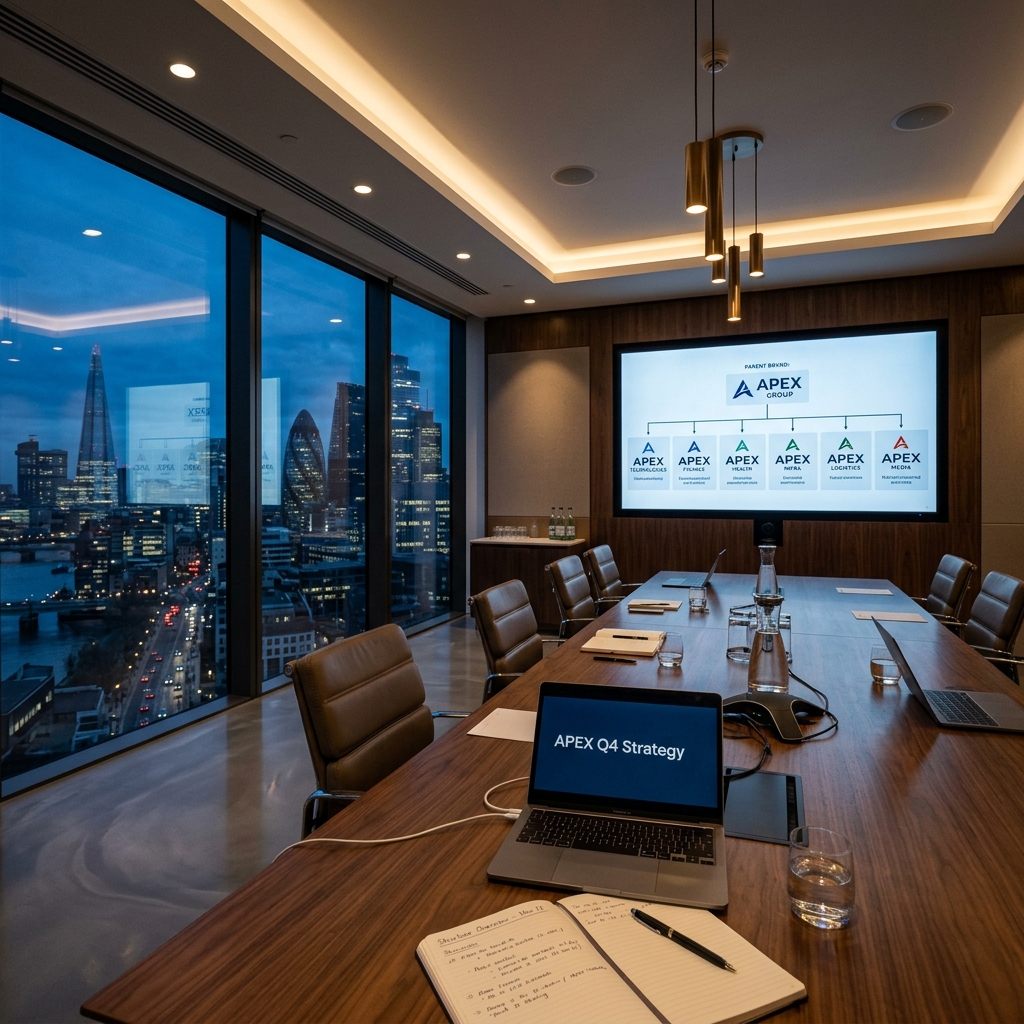
Most VC-backed companies think about brand the wrong way. They treat it as an aesthetic problem. Logo. Colors. Website. Tagline. Get those sorted, hand it off to a designer, move on to the things that feel more urgent. Product. Hiring. Revenue. Brand architecture is not any of those things. It is the structural decision about how your company presents itself across products, markets and customer segments as it grows. Get it right early and it becomes a foundation that supports every new market entry, every product launch and every acquisition without requiring a rebuild. Get it wrong and you eventually hit a wall where the brand that served you at Series A is actively working against you at Series C. The companies that scale cleanly have usually made these structural decisions early. The ones that struggle with brand confusion at growth stage are almost always paying the price for decisions that were never made at all.
What Brand Architecture Actually Means
The term gets used loosely so it is worth being specific. Brand architecture is the system that defines the relationship between your parent brand and everything that sits under it. Your products. Your sub-brands. Your acquired companies. Your market-specific offerings. It answers the question of whether these things carry your company’s name, stand alone entirely or exist somewhere in between. Three broad models exist and each carries different implications for a scaling company. The first is a branded house. Everything carries the parent brand. Google is the example most people reach for. Gmail, Google Maps, Google Drive, Google Ads. All clearly Google. The parent brand does all the work. Every product launch adds equity to the same asset. The second is a house of brands. Each product or sub-brand operates independently. The parent company is invisible or nearly invisible to the end customer. Procter and Gamble is the classic case. Tide, Pampers, Gillette. Each a standalone brand with no visible connection to the parent. The third is a hybrid. Some products carry the parent brand. Others operate more independently. Most companies at scale end up somewhere in this middle space whether they planned to or not. The decision about which model fits a given company is not arbitrary. It flows from the business model, the growth strategy, the competitive landscape and where the company is headed. Making that decision deliberately rather than accidentally is what separates companies that scale with brand clarity from the ones that end up with a tangled architecture that requires expensive correction later.
Why This Decision Matters More at VC Scale
A bootstrapped company that grows slowly has time to let brand architecture evolve organically. The structure emerges from decisions made one at a time over years. There is room to correct course gradually. A VC-backed company does not have that luxury. Brand Architecture for VC-Backed Companies operates under specific pressures that make the stakes of getting this wrong significantly higher. Speed of growth means brand decisions get codified quickly and at scale. A positioning choice made at seed stage gets baked into investor decks, press coverage, hiring materials and product naming conventions before there is time to revisit whether it was the right choice. Reversing those decisions later is not just inconvenient. It is expensive and disruptive. Multiple stakeholders mean brand decisions have more downstream consequences. Investors are watching how the company presents itself in the market. Enterprise customers are making procurement decisions partly based on brand credibility. Talent is choosing between you and well-branded competitors. The brand is not just a customer-facing asset. It is doing work in multiple directions simultaneously. Acquisitions and product extensions happen faster. A company that acquires another business at Series B needs an immediate answer to how the acquired brand relates to the parent. A company launching a second product line needs to know whether it goes under the existing brand or gets its own identity. Without an architecture framework already in place, these decisions get made reactively and inconsistently.
The Investor Dimension
Brand architecture decisions directly affect how a company is perceived by the investment community and that perception has real consequences at every subsequent funding round. A company with a clear brand architecture presents as operationally mature. It signals that leadership thinks in systems rather than just in immediate tactics. That signal matters to institutional investors who are evaluating not just the current business but the organizational capacity to manage complexity at scale. A company with brand confusion, multiple products that feel disconnected, messaging that shifts depending on which part of the website you land on, names that do not relate logically to each other, sends a different signal. Even if the underlying business metrics are strong, the brand presentation suggests a leadership team that is reacting rather than planning. This is not about polish for its own sake. It is about whether the brand architecture can hold up under the scrutiny that comes with larger funding rounds, strategic partnerships and potential acquirer interest.
Where Most Startups Go Wrong
The most common mistake is building brand architecture around the first product rather than the company. A startup launches with a single product. The company name and the product name become the same thing in practice even if they are technically different on paper. All marketing, all content, all positioning is built around that product and its specific use case. Then the company raises a Series A and the roadmap expands. A second product is in development. A new customer segment needs to be addressed. And suddenly the brand that was built entirely around the first product is working against the broader story the company needs to tell. The company name sounds too narrow for the expanded vision. The original positioning does not accommodate the new product. The brand equity that was built is attached to something that no longer fully represents what the company is. This is not a hypothetical. It plays out consistently across the VC-backed startup landscape. The cost of rebuilding at growth stage, in terms of time, money and market confusion, is significant. The alternative is to build the architecture around the company’s long-term direction from the start, even when only one product exists. That means naming decisions, visual identity choices and positioning frameworks that can expand without breaking.
Branding Through Acquisitions
Many VC-backed companies reach a point where inorganic growth becomes part of the strategy. Acquiring a smaller competitor. Picking up a complementary product. Bringing in a team with capabilities the parent company wants to internalize. Every acquisition is a brand architecture decision. Do you fold the acquired company into your existing brand immediately? Do you keep it running under its own name with some signal of the parent relationship? Do you let it operate entirely independently under its own identity while you figure out the long-term plan? Each choice has tradeoffs. Folding in quickly maximizes parent brand equity and simplifies the portfolio but can destroy acquired brand equity and create confusion among the acquired company’s existing customers. Keeping it separate preserves that equity but creates a portfolio management challenge and can dilute the parent brand story. Branding for VC-Backed Startups that are acquisition-active requires a framework that makes these decisions consistently rather than case by case. When each acquisition gets its own bespoke branding decision, the result over time is an incoherent portfolio that is difficult to explain to investors, enterprise customers or potential future acquirers. A pre-established framework means the decision tree is already built. Each new acquisition gets evaluated against the existing architecture and placed accordingly. The portfolio tells a coherent story rather than a collection of unrelated chapters.
Scaling Into Enterprise Markets
Many VC-backed companies reach a point where they need to move upmarket. The SMB base that drove early growth has a ceiling. Enterprise contracts are where the next phase of revenue growth lives. Enterprise buying decisions are not made the same way SMB decisions are. They involve multiple stakeholders, longer sales cycles and a much more rigorous evaluation of the vendor as an organization rather than just the product as a solution. Brand architecture plays a direct role in enterprise perception. An enterprise buyer looking at a company with a clear, organized brand presence, coherent product family, consistent messaging across touchpoints and a visible investment in how the company presents itself is evaluating a different kind of vendor than one whose brand looks like it was assembled from spare parts. This is not about whether the website looks expensive. It is about whether the brand signals an organization that operates with the kind of intentionality that enterprise customers need from vendors they are committing to significant contracts with. Companies that built their architecture with enterprise in mind from the beginning enter those sales conversations with a structural advantage that companies trying to retrofit their brand for enterprise buyers simply do not have.
What Getting This Right Looks Like in Practice
Building brand architecture at a VC-backed company starts with a set of decisions that need to be made explicitly rather than allowed to emerge from circumstance. What is the relationship between the company name and the product names going to be as the portfolio expands? How will acquired brands be treated? What is the long-term vision for the company and does the current brand structure support it or constrain it? What signals does the brand need to send to each of the different audiences that matter, investors, enterprise buyers, talent, consumers? These are strategic questions that sit at the intersection of brand and business. They require input from leadership, not just from the design team. The answers become the framework that governs every subsequent brand decision as the company grows. The companies that do this work early tend to find it pays returns across every subsequent phase of growth. Product launches are cleaner. Market entries are faster. Acquisitions integrate more smoothly. Fundraising conversations are more confident. The brand becomes an asset that scales alongside the business rather than a constraint that needs to be worked around.
The Window That Closes
Here is the thing about brand architecture decisions at a VC-backed company. There is a window where making them is relatively straightforward and a window where making them requires undoing a significant amount of work. Early stage, before the brand has been extensively codified in the market, the decisions are clean. The constraints are minimal. The cost of getting it right is low. Later stage, after the brand has been built into investor materials, product interfaces, enterprise contracts, media coverage and thousands of customer touchpoints, changing the architecture requires a coordinated effort that touches almost everything. It is doable. Companies do it. But it is significantly more expensive and disruptive than doing it before all of those touchpoints existed. The companies that scale fastest with the least friction are almost always the ones that treated brand architecture as an early strategic priority rather than a late-stage cleanup project. The foundation does not show once the building is up. But everything that gets built on top of it either benefits from it or fights against it every single day.

 NailaSEO6