
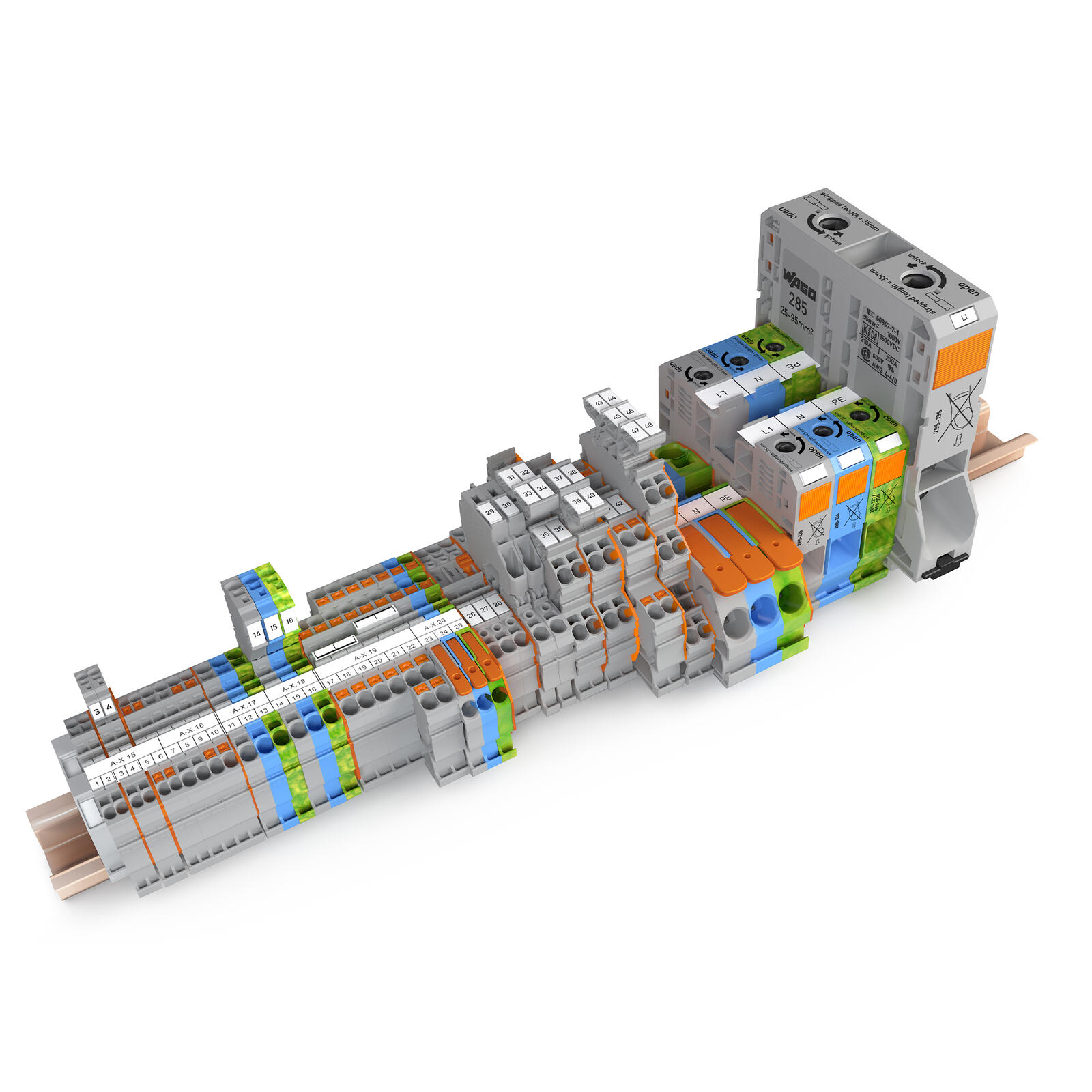
In every electrical system, the smallest details create the biggest operational challenges. Most engineers focus on components: sensors, controllers, breakers. But components are rarely the problem. The connections are.
Walk into any large-scale automation facility. You will see racks of well-engineered equipment. Look closer at the wiring; that is where the chaos lives. Every unmarked junction, every improvised splice adds up to a system nobody fully understands anymore.
Systems are not failing because of bad components. They are failing because nobody treated interconnection as a discipline. This is where terminal blocks become far more than simple connection points; they function as an intelligent control layer that improves organization, simplifies maintenance, and reduces long-term lifecycle risk across complex electrical infrastructure.
Electrical Complexity Is Growing Faster Than Design Methodologies
Every modern electrical system carries more I/O points than it did five years ago. Automation networks handle thousands of sensor inputs. Distributed energy systems add bidirectional power flows. Smart infrastructure layers data communication on top of power and control signals.
The Design Gap Nobody Talks About
Wiring practices still follow a linear model, one wire leads to one point. But modern systems are networked, behaving more like software architectures than traditional circuits. That gap produces unmanaged wire density, mixed signal types without segmentation, no separation between power and data lines, and a higher failure probability as complexity grows without structure.
Interconnection Density vs. System Transparency: The Trade-Off That Breaks Systems
Density is desirable. Packing more connections into a smaller enclosure reduces cabinet size, cuts material cost, and makes installations neater. But density carries a hidden cost.
| Factor | High Density (Unstructured) | High Density (With Terminal Blocks) |
| Space efficiency | High | High |
| Troubleshooting speed | Slow, hard-to-trace circuits | Fast, segmented, and labelled |
| Fault isolation | Difficult, cascading risk | Easy, localized by design |
| Maintenance clarity | Low, wiring obscures the structure | High, readable layout |
| Scalability | Poor, redesign required | Strong, modular expansion |
| Technician onboarding | Long learning curve | Short, standardized layout |
Terminal blocks resolve this tension by organizing interconnection into readable, segmented layers, giving engineers both density and visibility.
Terminal Blocks as a Decoupling Mechanism in Electrical Design
The best architectures decouple components from each other. Terminal blocks bring this principle to electrical design, creating defined separation points between layers that previously overlapped.
Why Decoupling Matters in Physical Systems Too
Terminal blocks decouple field wiring from control systems, installation from commissioning, and operation from maintenance. When a fault occurs at the field level, it stays there; it does not cascade into the control system. That single architectural decision prevents failures that cost industrial operators millions annually.
Contact Stability as a Determinant of Electrical Integrity
Connection quality is not static. Temperature cycles expand and contract metal. Vibration loosens fasteners. Oxidation increases resistance at junction points.
As micro-contact resistance rises, signal degradation occurs in low-voltage control circuits, and heat generation accelerates further degradation. Spring-pressure terminal block systems maintain constant contact force regardless of thermal expansion and vibration, no manual retorquing, no scheduled tightening intervals. Connection integrity sustains itself over the full service life.
Designing for Change: Terminal Blocks Enable Live System Evolution
No system stays the same. Rigid systems force engineers into a difficult choice: take the system offline or improvise and accumulate technical debt. Terminal blocks eliminate this dilemma. New circuits can be added while the system runs. Safe isolation allows localized work on live installations. This transforms a fixed installation into an adaptable infrastructure that grows with requirements.
Fault Containment and System Resilience
The most expensive electrical failures cascade, one fault triggers another until a significant portion of the system shuts down.
Terminal blocks localize faults through circuit segmentation, integrated test points, disconnect capabilities for isolating individual circuits, and clear visual identification that reduces diagnostic time from hours to minutes. Systems built with structured terminal block layouts consistently show faster fault isolation and reduced mean time to repair.
Space Optimization Without Sacrificing Accessibility
High-density enclosures create a real engineering challenge. Packing more connections into less space often means sacrificing access. Terminal blocks solve this without compromise.
- Multi-level configurations stack connections vertically
- Compact footprints reduce cabinet real estate needs
- Structured layouts keep every connection point reachable
The key distinction here is that density and accessibility are not opposites. Terminal blocks prove that a compact system can still be a serviceable one. Engineers do not have to choose between space savings and maintenance access.
Standardization as a Risk-Reduction Strategy
Terminal blocks enforce standardization through repeatable layouts, predictable wiring schemes any qualified technician can interpret, and color-coded labeled systems that reduce identification errors. This enables faster scaling across projects, easier cross-team collaboration, reduced training time, and lower installation error rates.
Lifecycle Economics: From Installation Cost to Operational Efficiency
Initial installation cost is the wrong metric for evaluating connection architecture. The real cost of an electrical system plays out over its full operational life, typically ten to twenty-five years in industrial and infrastructure applications.
Terminal blocks improve lifecycle economics across every stage:
- Installation: faster termination reduces labor hours at the front end
- Commissioning: structured layouts reduce test time and error-chasing
- Operation: maintenance-free spring connections eliminate scheduled retorquing programs
- Maintenance: fault isolation speed reduces downtime duration and frequency
- Expansion: modular architecture removes redesign costs during system evolution
- Decommissioning: clear circuit identification simplifies safe disconnection
Systems built on structured terminal block architecture consistently outperform alternatives on total cost of ownership.
Conclusion: Interconnection as a Design Discipline
Terminal blocks are not passive components. They are active architectural tools that determine how a system behaves under load, responds to faults, accommodates change, and performs across its full operational life. As systems grow more complex, engineering the connection layer becomes as critical as engineering the system itself. The teams that understand this build systems that last. The ones that do not are still chasing wiring faults in year three.
FAQs
What are terminal blocks used for in electrical systems?
They create structured, accessible connection points between conductors, organizing wiring into segmented, labeled, and serviceable layouts across power, signal, and data circuits.
How do terminal blocks improve system reliability?
Spring-pressure connections maintain consistent contact force over time, resisting thermal cycling and vibration without manual intervention, preserving electrical integrity across the full service life.
Why are terminal blocks important in complex control panels?
They enforce structure in high-density environments where unmanaged wiring creates diagnostic blind spots, reducing troubleshooting time and limiting fault propagation.
How do terminal blocks help reduce maintenance and downtime?
Maintenance-free connections eliminate scheduled retorquing. Integrated disconnect and test points allow targeted fault isolation without shutting down adjacent circuits, reducing both frequency and duration of maintenance interventions.
 mindswealth
  lizatim
  glennprior