
Introduction
There’s something quietly powerful about sitting down with a pen, an open page, and an honest heart. A devotional journal isn’t just a notebook — it’s a space where your faith actually gets to breathe. It’s where you stop performing and start listening.
If you’ve ever felt like your spiritual life was running on autopilot, or like you were going through the motions of faith without really feeling it, journaling might be the thing that brings it back to life. Not because it’s a discipline to master, but because it creates the kind of stillness where God can actually get a word in.
What Makes a Devotional Journal Different from Regular Journaling
Most people think journaling is just writing down what happened in your day. And sure, it can be that. But a devotional journal is built around something specific — your relationship with God. It’s intentional. There’s scripture woven into it. There are prompts designed to move you out of your head and into honest conversation with Him. It’s less diary, more dialogue.
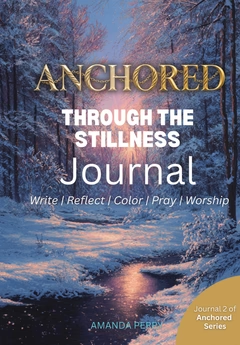
Amanda Perry’s Anchored journal series captures this beautifully. Each journal in the series is structured around a specific season of life — wilderness seasons, seasons of stillness, seasons where trust feels impossible — and every page is designed to help you engage with God in a real and personal way. The difference between a blank journal and a guided one is massive, especially when you’re exhausted or spiritually dry. You don’t always have the words. That’s exactly when reflective prompts, scripture anchors, and closing prayers carry you.
There’s also something about the physical act of writing that forces you to slow down. Your mind can race through a hundred thoughts in seconds. Your hand can’t. That gap — that deliberate pace — is where reflection actually happens.
How Journaling Builds Consistency in Your Faith Walk
Faith that only shows up on Sundays tends to feel thin. Real spiritual depth gets built in the small, repeated moments — the Tuesday mornings before the kids wake up, the five minutes in a parked car before heading into work. A devotional journal gives those small moments structure and meaning.
Think about it this way: you wouldn’t expect a relationship to grow if you only spoke to someone once a week for an hour. The same is true of your relationship with God. Consistent time in scripture and reflection — even ten or fifteen minutes — compounds over weeks and months into something that genuinely changes how you see life, how you respond to pressure, how you process grief and disappointment.
Amanda Perry’s free 7-day burnout devotional is a great example of how consistency can be built gently and accessibly. It doesn’t demand perfection. It invites you to show up as you are — exhausted, uncertain, stretched thin — and begin reconnecting with God right there. That’s the spirit behind good devotional journaling. It’s not about performance. It’s about presence.
When you journal regularly, you also start to notice patterns. You see how God has been faithful in moments you barely remembered. You track answered prayers. You catch yourself writing through fear and landing somewhere that feels like peace. That’s not coincidence — that’s the fruit of showing up consistently.
The Role of Scripture in Deepening Your Journal Practice
Scripture isn’t decoration in a devotional journal. It’s the foundation. When you write around a verse — sitting with it, questioning it, applying it to what you’re actually walking through — the Word stops being abstract and starts being alive. It gets personal.
Hebrews 4:12 describes scripture as living and active. That’s not poetic language. That’s a description of what happens when you genuinely engage with it. A verse you’ve read a hundred times can say something completely new when you bring a specific heartache or question to it.
The Anchored series journals from Amanda Perry weave scripture throughout every section — not as a checklist but as an anchor, which is literally the point. When life is destabilizing, you’re not anchored in your feelings or your circumstances. You’re anchored in what God has said. That distinction matters enormously when you’re in a hard season.
Writing a verse out by hand, then responding to it honestly, then praying through it — that sequence goes so much deeper than reading it passively. It’s the difference between skimming a map and actually walking the terrain.
Journaling Through Hard Seasons Without Losing Your Faith
This is where devotional journaling proves its worth most clearly. Anyone can feel close to God when life is going well. The test comes in the wilderness, in the stillness that feels like silence, in the grief that makes prayer feel hollow. And it’s precisely in those seasons that having a structured, guided journaling practice can hold you together when you feel like you’re coming apart.
Amanda Perry writes from this place herself. Her story isn’t about having it together — it’s about complete undoing, about carrying trauma and pressure and grief until everything gave way. And it was in that collapse, not before it, that real encounter happened. Her resources, including the Anchored Through the Wilderness journal, were forged in that kind of raw, hard place. That’s why they work. They’re not theoretical. They don’t offer tidy answers. They offer honest companionship and a way to keep walking with God even when the path feels invisible.
Writing through a hard season also gives you somewhere to put the things you can’t say out loud. Anger at God. Doubt. Exhaustion. Grief. Those things don’t disappear because you ignore them — they go underground and corrode your faith quietly. Putting them on paper, honestly, is a form of prayer. Psalm 22 starts with “My God, my God, why have you forsaken me?” That’s scripture. Honesty in anguish has always been part of the faith conversation.
Worship, Creativity, and the Unexpected Ways Journaling Opens You Up
One of the things that sets the Anchored journal series apart is that it doesn’t treat faith as purely intellectual. Worship songs are linked to each section. Scripture-based colouring pages are included for reflection and stillness. These aren’t gimmicks. They’re recognizing something true: that God meets us in creative spaces too.
There’s a reason Amanda Perry’s blog post on creativity explores exactly this — the idea that God shows up in the quiet moments of creative engagement. Colouring a scripture passage. Writing out a prayer that turns into something like a poem. Sitting with a worship song before picking up your pen. These things lower your defences in ways that pure cognitive effort can’t. They get past the analytical, performance-oriented part of your brain and touch something deeper.
Neuroscience research supports the idea that expressive writing — putting your thoughts and emotions into words — genuinely affects the brain’s processing of stress and emotion. When you pair that with faith-based intention, scripture, and prayer, the impact goes further than therapy alone can reach.
Practical Ways to Start and Sustain Your Journaling Practice
Getting started is usually easier than staying consistent. A few things that genuinely help:
Pick a time that already has stillness attached to it. Early morning before the house wakes up. A lunch break away from your screen. The few minutes after the kids go to bed. You don’t need an hour — fifteen minutes is enough to get real.
Start with a guided journal rather than a blank page. When you’re spiritually depleted, staring at a blank page adds pressure you don’t need. A guided journal like the Anchored and Rooted journal gives you a starting point — a prompt, a verse, a prayer structure — so you can enter the practice without having to engineer it from scratch.
Don’t edit as you write. This is a conversation, not a performance. Write what’s actually in you, not what you think should be there.
Read back through old entries occasionally. This is where faith gets visibly traced. You’ll see prayers answered you’d forgotten about. You’ll notice how your perspective shifted through a season. You’ll have evidence, in your own handwriting, that God was with you.
Let worship lead the way in. Before you write, play a song that softens your heart. Sit in it for two minutes before picking up the pen. You’ll write differently.
Frequently Asked Questions
What is a devotional journal and how is it different from a regular journal?
A devotional journal is a structured, faith-based journaling practice that pairs scripture, reflection prompts, and prayer to create intentional time with God. Unlike a standard diary, it’s designed to deepen your relationship with Him rather than just record events.
How long should I spend in my devotional journal each day?
Fifteen minutes is genuinely enough to make an impact. Consistency matters more than duration. Even a short daily practice builds spiritual depth over time.
Can journaling help during a spiritual dry season?
Absolutely. In fact, guided devotional journals are most useful precisely when you feel spiritually dry. They provide structure when motivation is low and give you a path back to connection with God when you can’t find the words yourself.
Do I need to be a good writer to keep a devotional journal?
Not at all. This isn’t writing for an audience — it’s a conversation. You can write in fragments, questions, prayers, or single sentences. Grammar and eloquence are irrelevant here.
Where can I find a good guided devotional journal to start with?
Amanda Perry’s Anchored journal series is a strong starting point — each journal is season-specific, scripture-anchored, and designed for real life rather than ideal circumstances. There’s also a free 7-day burnout devotional available if you want to try before committing to a full journal.
Conclusion
A devotional journal is one of the most underestimated tools in a believer’s life. It costs very little, asks very little, and returns something that most other spiritual disciplines struggle to replicate: the experience of God speaking directly into your specific story. Not in general terms. Not in someone else’s sermon. But in the quiet space you’ve made — on the page, in your own words, with His truth woven through it.
The Anchored journal series by Amanda Perry was built for this kind of practice — not for the spiritually sorted but for the exhausted, the doubting, the ones who are still showing up even when they’re barely holding on. If that’s you, a devotional journal isn’t another thing to add to your list. It’s the thing that might finally help the rest of your list make sense.

 deepakkumar902390