
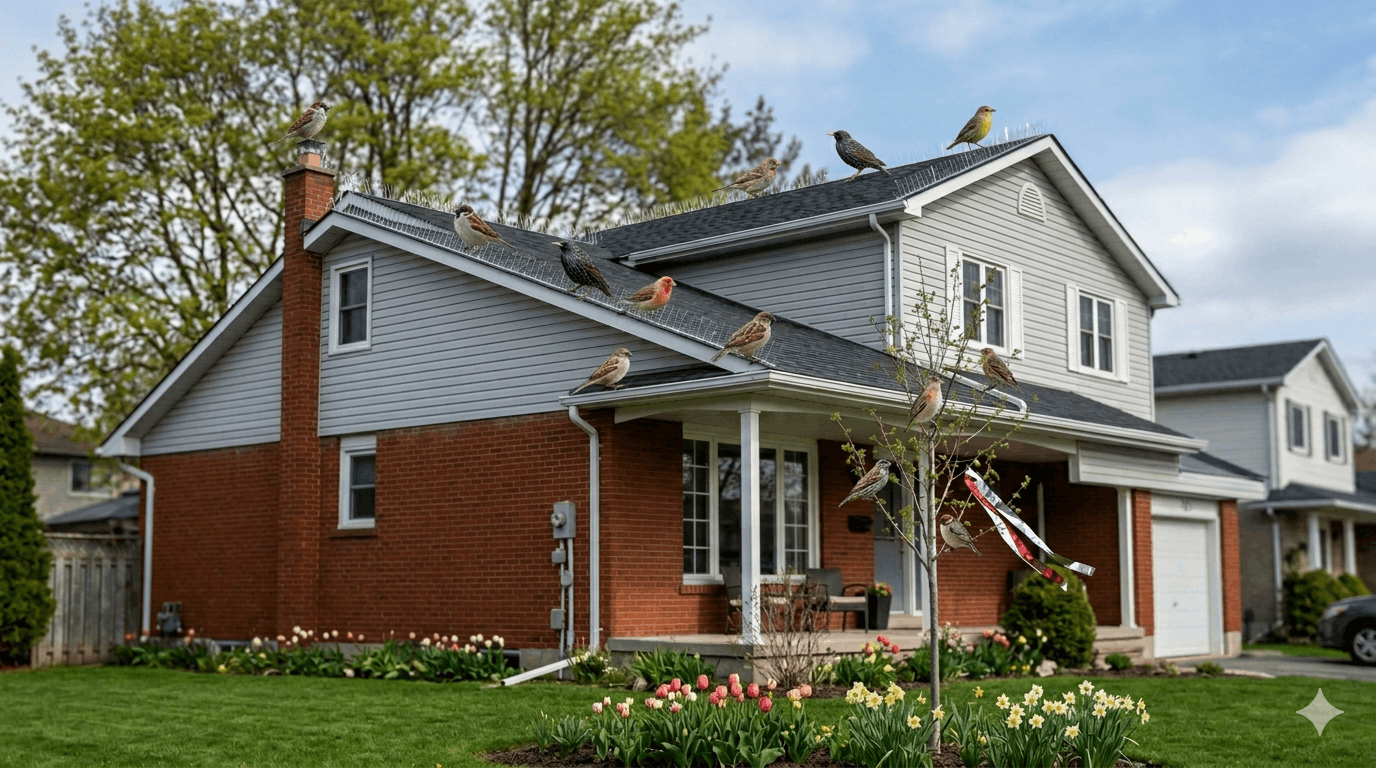
Birds look harmless on your rooftop. Until they’re not.
A few pigeons today can become a full-blown infestation by next season. Pigeons breed up to six times a year. Starlings nest in large, noisy colonies. Canada geese take over outdoor spaces and leave droppings everywhere. And by the time most people notice the problem, it’s already much bigger than it looks.
If you’re dealing with birds on your property, this guide will walk you through everything you need to know — from why it happens to how to fix it properly.
Why Birds Choose Your Property
Birds aren’t random. They pick your building for a reason.
Rooftop HVAC units provide shelter and warmth. Open vents make perfect nesting spots. Flat ledges are ideal for pigeons to roost. Nearby food sources — whether it’s a restaurant dumpster, parking lot garbage, or even a pond — bring Canada geese and waterfowl in from surrounding areas.
In cities and growing towns across Canada, rapid construction is actually making the problem worse. New buildings with fresh eaves, soffits, and open vents are exactly what starlings and house sparrows are looking for. They move in before you even notice.
And unlike many pests, birds don’t go away on their own. Once they establish a nesting spot, they come back — season after season.
The Real Risks of a Bird Infestation
A lot of people think birds are a nuisance at worst. That’s not accurate.
Health risks are serious. Bird droppings carry diseases that can affect humans, including:
- Histoplasmosis — a fungal lung disease that spreads through dried droppings disturbed by wind or cleaning
- Cryptococcosis — a yeast infection linked to pigeon and starling droppings, affecting the lungs and nervous system
- Psittacosis — a bacterial illness that can develop into pneumonia
- Salmonella and E. coli — both traced to fecal contamination of food and water surfaces
The HVAC risk is particularly overlooked. When droppings dry inside ducts and vents, microscopic particles travel through your air system and get inhaled by everyone in the building.
Structural damage is costly too. Uric acid in bird droppings corrodes concrete, metal, and roofing materials. Nesting debris blocks gutters and drains. Nests built near electrical wiring are a recognized fire hazard.
One example that puts it in perspective: a pigeon problem on a bridge in Saskatoon that went unmanaged for decades ended up costing the city close to $900,000 in cleanup and rehabilitation costs. The lesson? The longer you wait, the more expensive it gets.
Signs You Have a Bird Problem
Not sure if your situation needs professional attention? Here are the key warning signs:
- Droppings are building up on ledges, walkways, windowsills, or signage
- Scratching or chirping sounds coming from inside vents or roof spaces
- Nesting material — twigs, feathers, leaves — around the roofline
- A persistent smell near the eaves or mechanical areas
- The same birds returning to the same spots day after day
If two or more of these apply, it’s time to act — not wait.
What Bird Control Professionals Actually Do
Modern bird control goes well beyond shooing birds off a ledge. A professional pest control company uses an Integrated Pest Management (IPM) approach, meaning they assess your specific property and combine methods to get lasting results.
Here’s a breakdown of what they typically use:
Physical deterrents like bird spikes (stainless steel or plastic, installed on ledges), bird netting (used for loading docks, warehouses, and open building facades), slope panels, and bird wire. These prevent birds from landing without harming them.
Electrical and optical deterrents like low-voltage electric tracks that discourage landing, optical gel that disorients birds using UV light, laser systems for large open spaces, and sound units used as supplementary tools.
Trapping and removal when an active bird population needs to be reduced. This must follow the rules of the Migratory Birds Convention Act, which governs the handling of many protected bird species in Canada. A licensed technician knows which species require permits and which don’t.
Cleanup and habitat modification — removing food and water sources that attract birds, performing safe biohazard cleanup of droppings using HEPA equipment, and sanitizing nesting sites to discourage birds from returning.
Why DIY Bird Control Usually Fails
The plastic owl. The reflective tape. The spike strip from the hardware store. We’ve all seen them.
The problem is birds are smart and adaptable. Fake predators stop working within days once birds figure out the “threat” never moves. Store-bought spike strips are often too narrow, and pigeons need only a few centimetres of flat space beside a spike to roost comfortably. Loose netting without sealed edges can actually trap birds inside — which is both an animal welfare issue and potentially a legal one in Canada.
More importantly, DIY doesn’t address the root cause. Why are birds choosing your property? What’s attracting them? Where are the gaps in the structure? Without answering those questions, any deterrent is just guesswork. You’ll move the problem a few feet, not solve it.
If birds are returning repeatedly, nesting actively, or getting inside the building — the window for a quick fix has already passed.
What Does Bird Control Cost in Canada?
There’s no single answer, because the cost depends on your property size, the bird species involved, the severity of the infestation, and which methods are required.
A single deterrent installation on a small ledge is a very different job from a full exclusion program covering a large commercial rooftop.
What’s consistently true across the industry: the earlier you act, the less you pay. A small infestation caught before droppings cause structural damage or nesting debris blocks your drains is almost always cheaper to fix than one that’s been left for a full season or two.
The smartest first step is always to book an on-site inspection and get a proper quote.
What to Expect From a Professional Service
Here’s what a typical bird control engagement looks like from start to finish:
- Inspection — The technician identifies the bird species, nesting sites, damage, and entry points.
- Species check — They confirm protected status under Canadian wildlife law.
- Custom plan — A tailored combination of exclusion, deterrents, and/or removal is recommended.
- Installation — Physical barriers, deterrent systems, or traps are installed.
- Cleanup — Droppings are safely removed, and the area is disinfected.
- Follow-up — Monitoring visits ensure the problem stays solved and catch any new activity early.
📞 Ready to Solve Your Bird Problem?
Don’t let a small bird issue turn into a costly infestation. The sooner you act, the simpler and more affordable the solution.
4K Pest Control provides professional, humane bird removal and bird-proofing across Bradford, the Greater Toronto Area, and surrounding Ontario communities. Our licensed technicians follow all Canadian wildlife regulations and use the full range of IPM-approved tools and methods.
👉 Visit 4kpestcontrol to book your inspection today.
For more pest control tips, guides, and updates, follow us on Medium: @4kpestcontrol.ca
Frequently Asked Questions
How much does bird control cost in Canada? Costs vary based on property size, bird species, and the methods required. Smaller jobs like a single ledge treatment cost less; larger commercial projects involving netting, full exclusion systems, and biohazard cleanup cost more. An on-site assessment is the most accurate way to get a quote.
Is it legal to remove bird nests in Canada? It depends on the species. Many birds — including most migratory species — are protected under the Migratory Birds Convention Act. Removing active nests without proper permits can result in significant fines. Always use a licensed professional to stay on the right side of the law.
Can I handle a bird problem myself? DIY methods work for very small, early-stage problems. However, once birds have established a nesting routine, store-bought solutions rarely last. A professional solves the root cause, not just the symptom.
Which businesses are most at risk? Any business with a rooftop, loading dock, or outdoor area is vulnerable. Food processing, hospitality, healthcare, manufacturing, retail centres, and multi-unit residential buildings are among the most commonly affected.
Will bird control disrupt my business? Most treatments are completed with minimal disruption. Work is often scheduled during off-hours or done in phases. Your technician will discuss scheduling during the initial assessment.
Do birds really cause that much structural damage? Yes. The uric acid in bird droppings is highly corrosive — it eats through concrete, metal, and roofing materials over time. Add blocked drains, nesting debris near electrical systems, and the fire hazard that creates, and the costs add up quickly. Early action is always the smarter financial decision.
How do I get started? Simple — visit 4kpestcontrol or reach out directly to book a property inspection. One call is all it takes.
For more expert pest control guides, follow 4K Pest Control on Medium: medium.com/@4kpestcontrol.ca
 username003
  NailaSEO6