
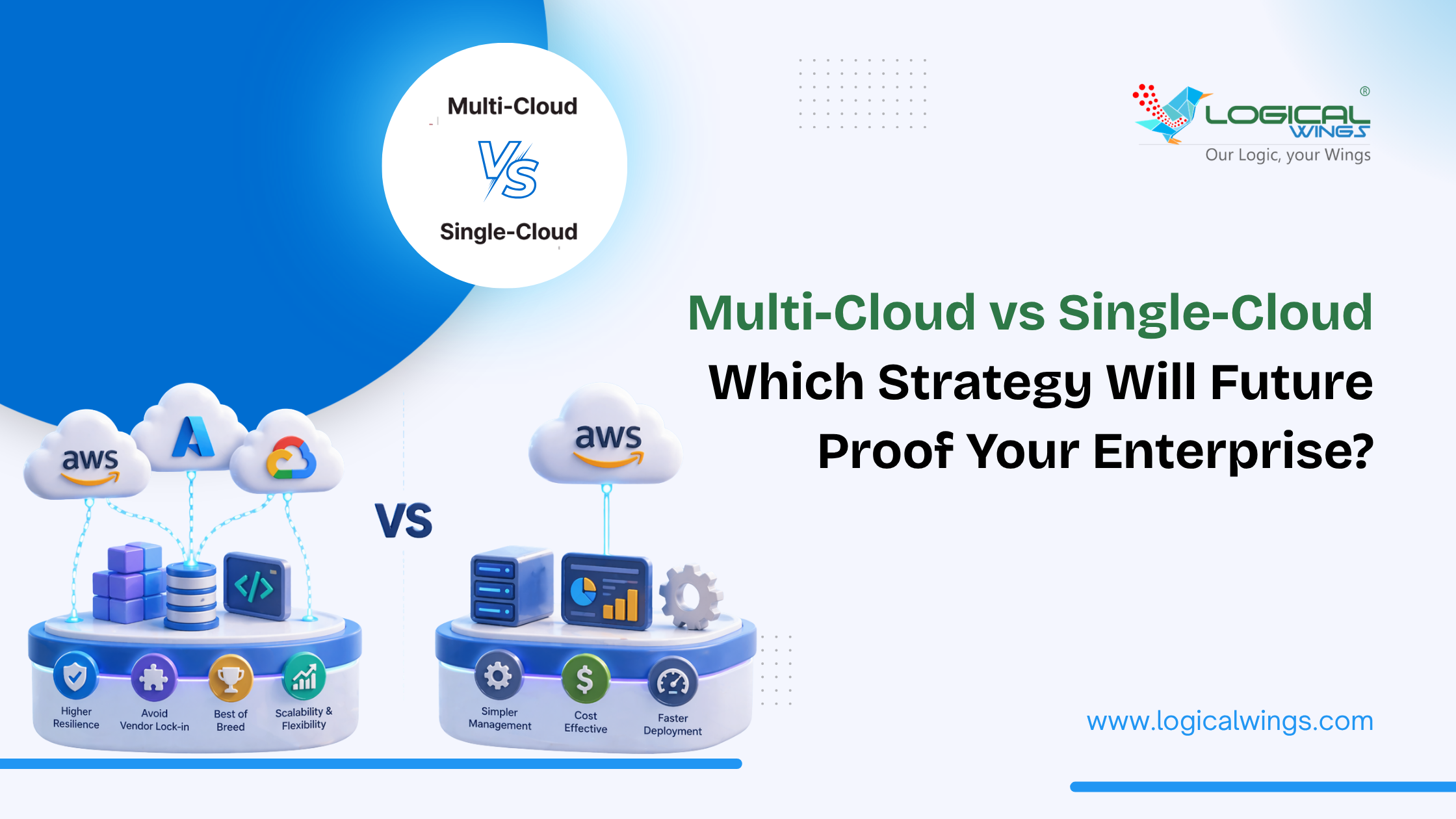
In today’s rapidly evolving technology landscape, choosing between Multi-Cloud vs Single-Cloud strategies has become one of the most critical decisions enterprise leaders face. As organizations accelerate their cloud migration services initiatives, the stakes have never been higher. Your cloud services architecture doesn’t just impact your current operationsit fundamentally shapes your organization’s agility, resilience, and competitive positioning for years to come.
The debate between multi-cloud and single-cloud approaches isn’t simply a technical consideration. It’s a strategic business decision that influences everything from operational costs and vendor relationships to innovation velocity and regulatory compliance. Some enterprises swear by the simplicity and deep integration of a single-cloud strategy, while others champion the flexibility and risk mitigation inherent in multi-cloud deployments.
This comprehensive guide examines both cloud strategies in depth, providing enterprise decision-makers with the practical insights needed to determine which approach will genuinely future-proof their organizations. Whether you’re embarking on your first cloud migration or reconsidering your existing cloud services architecture, understanding the nuances of each strategy is essential to making an informed choice.
What Is a Single-Cloud Strategy?
A single-cloud strategy means committing your organization’s cloud infrastructure, applications, and services to one primary cloud providerwhether that’s Amazon Web Services (AWS), Microsoft Azure, Google Cloud Platform (GCP), or another major vendor. This approach consolidates your cloud services under a unified ecosystem, creating a standardized environment where all workloads run on the same platform’s infrastructure.
In practice, a single-cloud strategy doesn’t necessarily mean you exclusively use one provider for absolutely everything. Many organizations maintain hybrid environments where on-premises systems coexist with their chosen cloud provider. However, the defining characteristic is that when moving to the cloud, all workloads migrate to the same vendor’s platform, creating a homogeneous cloud environment.
This consolidation strategy appeals to organizations seeking deep platform expertise, streamlined operations, and maximum leverage of a single vendor’s integrated toolset. Companies pursuing single-cloud approaches typically negotiate comprehensive enterprise agreements with their chosen provider, often securing volume discounts and dedicated support in exchange for commitment.
Benefits of a Single-Cloud Strategy
Organizations that successfully execute a single-cloud strategy often realize significant advantages across operational, financial, and technical dimensions:
Simplified Operations and Management
Managing a single cloud environment dramatically reduces operational complexity. Your IT teams develop deep expertise in one platform’s tools, services, and best practices rather than spreading their knowledge across multiple providers. This specialization accelerates problem resolution, optimizes resource utilization, and enables teams to leverage advanced platform-specific features that might remain underutilized in a multi-cloud scenario.
Cost Predictability and Volume Discounts
Consolidating spending with one cloud provider strengthens your negotiating position. Enterprise agreements typically offer tiered pricing that rewards commitment with substantial volume discountsoften 20-40% below list prices for large deployments. Additionally, single-cloud environments simplify cost management and forecasting since you’re working with one billing system, one set of pricing models, and one relationship to optimize.
Let’s connect: https://logicalwings.com/multi-cloud-vs-single-cloud-which-strategy-will-future-proof-your-enterprise/
Call us: 9665797912
 synaworld43
  usloverboyhat
  mindswealth