
Automotive manufacturers depend upon producing the safest vehicles possible that perform reliably and provide customers with an enjoyable experience. As a result, manufacturers use components that either exceed or meet today’s demanding operational requirements. Due to the high levels of mechanical integrity and structural integrity found with forged components, forging has been one of the most trusted and successful manufacturing processes utilized in the production of automotive parts by producing parts with high-quality materials.
Forge components can be found in many types of vehicles, including but not limited to cars, trucks, agriculture, construction, and very high-performance racing vehicles. This guide will help you understand the definition of forged automotive parts, provide examples of forged automotive parts, discuss each stage of the manufacturing process for forging automotive parts, and explain the various types of processes used in producing forged automotive parts, as well as providing you with information about the type of quality testing standards related to forged automotive parts.
What Are Forged Automotive Components?
Automotive forged components are those that were formed through forging—a process in which compressive forces (via hammers or presses) are used to shape metal into its final form. In addition to producing a stronger, more durable product compared to cast or machined parts; forging also refines the grain structure of the metal being forged and gives it superior toughness, fatigue resistance, and overall performance than that of cast or machined parts do.
Unlike casting, where hot liquid metal is poured into a mold to create the finished part, forging requires the deformation of solid metal into its finished shape and mechanical characteristics through both temperature and pressure controlled methods.
Key Characteristics of Forged Components
- High mechanical strength
- Excellent fatigue resistance
- Superior impact toughness
- Improved grain flow structure
- Enhanced wear resistance
- Longer service life
- Better dimensional stability
Examples of Forged Automotive Components and Their Uses
Forged automotive components have very common usages throughout critical automotive applications where strength, durability, and reliability are demanded. Some very commonly used forged auto parts include; Crankshafts which are responsible for converting the up and down motion of the pistons into rotational power (crankshafts rotate); Connecting rods which connect the pistons to the crankshaft (they connect piston assembly to the crankshaft); Steering knuckles which connect the wheel hubs to the steering and suspension systems (the wheel hubs rotate about the steering knuckle); Gear blanks and production gears used in differentials and transmissions; Axle shafts which transfer power to the wheels (axle shafts have different workloads for rear and front); Wheel hubs which support the rotation of the wheel; Suspension components (control arms, ball joints, and tie rod ends). Because of the way the forging process manipulates the molecular structure of a given material, forged automotive components typically possess superior fatigue strength, have excellent impact and torsional resistance, display increased load-carrying capacities, possess maximum resistance to wear, increase the stability of a vehicle, and provide extended service (life cycle). This is why they have become such a popular solution for many of the increasingly “demanding” uses found in modern-day automobiles.
Stages Involved in the Manufacturing Process of Forged Automotive Components
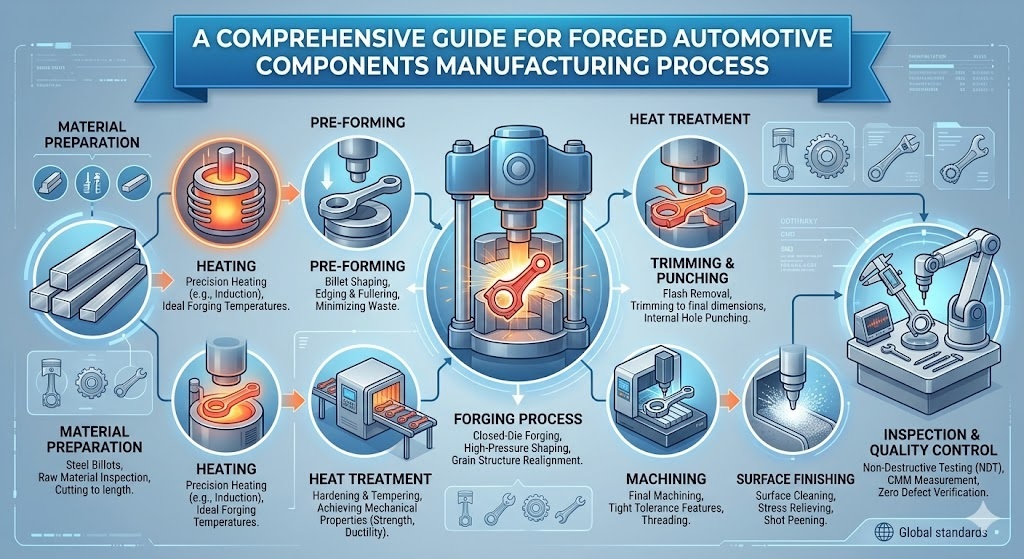
When manufacturing forged automotive components for automobiles, there are many careful manufacturing steps taken to create a product with the greatest possible strength, lifespan, and accurate dimensions. This starts with choosing raw materials which will be used in production i.e., Carbon Steel, Alloy Steels, Stainless Steels, Aluminium Alloys and Titanium. The selection is based on load requirements, resistance to corrosion, weight and environmental conditions which the product will be used against. The material types are then cut into suitably sized billets prior to being heated to the correct temperature to improve formability (plasticity). The next step in the process of making a forged part is to forge the heated billet into the desired shape under high compressive forces (forging process). After the part has been forged, trimming is done to remove any unnecessary flash from the part and achieve the desired completed shape of the component. Heat treatments such as normalizing, quenching, tempering and annealing are then performed to enhance the mechanical properties of the component prior to final machining and achieving the final dimensions and tolerances of the component. Finally, surface treatment processes such as shot blasting, phosphating, galvanising, powder coating and electroplating are applied to increase the aesthetics and resistance to corrosion of the component. All finished products are then put through a rigorous inspection and testing process to ensure they meet the standards in the automotive industry, prior to dispatching.
Processes Involved in Forged Automotive Components Manufacturing
Various forging methods are employed in the manufacture of automotive components depending on the part geometry, production volume, and performance requirements. Open die forging involves compressing metal between flat dies and is commonly used for large shafts and heavy-duty components due to its flexibility. Closed die or impression die forging shapes metal within precision die cavities, making it ideal for crankshafts, connecting rods, and steering components that require high accuracy and repeatability. Cold forging is performed at or near room temperature and is widely used for fasteners and small precision parts, offering excellent surface finish and dimensional accuracy. Warm forging is carried out at intermediate temperatures, providing improved material flow, reduced forging forces, and better dimensional control. Hot forging, conducted above the metal’s recrystallization temperature, enables the production of complex shapes with enhanced grain flow and superior mechanical properties, making it one of the most widely used forging processes in the automotive industry.
Testing, Quality, and Performance Standards for Forged Automotive Components
Forged automotive components undergo comprehensive quality and performance testing to ensure they meet stringent safety, reliability, and durability requirements. Dimensional inspections using Coordinate Measuring Machines (CMM), vernier calipers, micrometers, and laser measuring systems verify accuracy and compliance with engineering specifications. Mechanical testing, including tensile, hardness, impact, and fatigue tests, evaluates strength, toughness, wear resistance, and long-term durability under cyclic loads. Non-destructive testing (NDT) methods such as Ultrasonic Testing (UT), Magnetic Particle Inspection (MPI), Dye Penetrant Testing (DPT), and Radiographic Testing (RT) are employed to detect internal and surface defects without damaging the component. Metallurgical examinations, including grain flow analysis, microstructure evaluation, inclusion analysis, and decarburization assessment, confirm the effectiveness of forging and heat treatment processes. Additionally, performance tests such as torque, load, wear, vibration, and corrosion resistance testing simulate real-world operating conditions to ensure the components deliver consistent performance throughout their service life.
International Quality Standards for Forged Automotive Components
Leading manufacturers of forged automotive components comply with globally recognized standards such as IATF 16949 for automotive quality management, ISO 9001 for quality assurance, ISO 14001 for environmental management, ISO 45001 for occupational health and safety, along with ASTM, SAE, DIN, and JIS standards for material specifications, testing procedures, and engineering requirements. Adherence to these standards ensures consistent product quality, reliability, safety, regulatory compliance, and acceptance across global automotive supply chains.
Conclusion
Forged automotive components form the backbone of modern vehicles, delivering exceptional strength, durability, and reliability in critical applications such as engines, transmissions, steering systems, and suspension assemblies. Through carefully controlled manufacturing stages—including material selection, forging, heat treatment, machining, and rigorous testing—manufacturers produce components capable of withstanding extreme mechanical and environmental stresses. As the automotive industry continues to evolve toward higher performance, safety, and sustainability, forged components will remain indispensable due to their superior mechanical properties and long service life.
 Lavishcars
  content
  harisyoung