
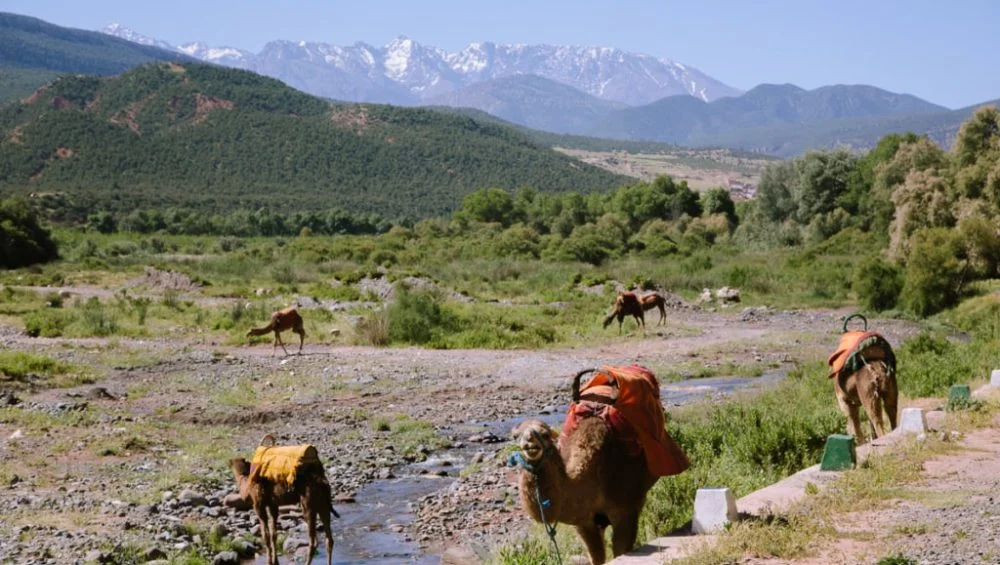
Stretching across North Africa, the Atlas Mountains form one of the most remarkable geological landscapes on Earth. Extending through Morocco, Algeria, and Tunisia, this mountain system has fascinated scientists for decades due to its unusual formation and complex history.
Unlike some mountain ranges that were created by straightforward continental collisions, the development of these peaks involved a combination of tectonic activity, ancient oceans, and millions of years of erosion.
Understanding how this mountain chain formed offers valuable insight into the forces that shape our planet. The geological story behind the Atlas Mountains is a tale that spans hundreds of millions of years, linking the movement of continents, the opening and closing of oceans, and the continuous transformation of Earth’s crust.
Ancient Origins Beneath the Surface
The foundation of this Atlas Mountains system dates back to the Paleozoic Era, more than 300 million years ago. During this period, much of the region that is now North Africa was affected by a major mountain-building event known as the Hercynian or Variscan Orogeny. This event occurred when ancient landmasses collided, creating extensive mountain belts across parts of Europe and Africa.
Although many of those early mountains have long since eroded away, their deep structural roots remain embedded within the crust. These ancient geological features later played a crucial role in guiding the formation of newer mountain ranges. Scientists believe that faults and weaknesses left behind by earlier tectonic activity influenced how the landscape evolved in later geological periods.
The Role of Ancient Oceans
Following the Paleozoic Era, tectonic conditions changed dramatically. During the Mesozoic Era, approximately 250 to 66 million years ago, the supercontinent Pangaea began to break apart. As the continents drifted away from one another, large ocean basins formed between them.
One of the most important bodies of water during this time was the Tethys Ocean. This vast ocean separated Africa from Eurasia and played a central role in shaping the geology of the surrounding regions. Sediments accumulated on the ocean floor for millions of years, creating thick layers of limestone, sandstone, and shale.
These sedimentary deposits would later become important components of the mountain system. Today, many rock formations found throughout the region provide evidence of this ancient marine environment, including fossils of sea creatures that once inhabited the Tethys Ocean.
Continental Movement and Compression
The modern geological story began when the African tectonic plate started moving northward toward the Eurasian plate. This gradual movement has been occurring for tens of millions of years and continues even today.
As Africa pushed against Eurasia, enormous compressional forces developed within the Earth’s crust. Rather than creating a single line of uplift, these forces affected a broad area across North Africa. Existing faults and crustal weaknesses became reactivated, causing sections of the crust to rise and fold.
The uplift associated with the Atlas Mountains was largely concentrated during the Cenozoic Era, especially over the last 65 million years. Geologists often compare this process to squeezing a thick carpet from both ends, causing folds and ridges to form. Similar mechanisms contributed to the development of other major mountain systems around the world.
A Unique Mountain-Building Process
What makes this range particularly interesting is that it does not fit neatly into traditional models of mountain formation. In many cases, large mountain belts emerge directly along the boundary where tectonic plates collide. However, much of the uplift in North Africa occurred hundreds of kilometers away from the main plate boundary.
Researchers suggest that deep mantle processes may have contributed to this unusual development. Some studies indicate that hot material rising from the Earth’s mantle caused parts of the crust to become thinner and more buoyant. This additional uplift may have amplified the effects of tectonic compression.
As a result, the region achieved elevations that are difficult to explain through crustal shortening alone. This combination of tectonic forces and mantle dynamics makes the geological history especially significant for understanding mountain-building processes worldwide.
The Influence of Erosion
While tectonic activity created the mountains, erosion has played an equally important role in shaping their appearance. Wind, rain, rivers, and temperature changes continuously wear down rock surfaces, carving valleys and exposing deeper geological layers.
Over millions of years, erosion removed vast quantities of material from elevated areas. Rivers transported sediments into surrounding basins, where they accumulated and formed new rock deposits. These processes revealed ancient rocks that provide valuable clues about the region’s geological past.
The dramatic landscapes seen today—including cliffs, rugged ridges, and deep gorges—are the result of a long interaction between uplift and erosion. Without these natural sculpting forces, the terrain would look very different.
Evidence Preserved in the Rocks
The rocks throughout the Atlas Mountains serve as a geological archive documenting hundreds of millions of years of Earth’s history. Sedimentary layers preserve records of ancient seas, deserts, and river systems. Fossils found within these rocks reveal how life evolved and adapted through changing environmental conditions.
Geologists study these formations to reconstruct past climates and tectonic events. Folded strata, fault lines, and uplifted marine sediments all provide evidence of the powerful forces that shaped the region. Each layer contributes a chapter to a story that spans multiple geological eras.
Modern technologies such as satellite imaging, seismic surveys, and radiometric dating have further improved scientists’ understanding of how these mountains formed and evolved.
Ongoing Geological Activity
Although the major phases of mountain building occurred millions of years ago, geological activity has not completely ceased. The African and Eurasian plates continue to move relative to one another, generating stress within the crust.
This ongoing movement occasionally produces earthquakes across parts of North Africa. While most seismic events are relatively moderate, they demonstrate that tectonic processes remain active beneath the surface. Researchers continue to monitor these movements to better understand regional geological hazards.
The landscape also continues to evolve through erosion, weathering, and sediment transport. In this sense, the geological story is still being written today.
Conclusion
The Atlas Mountains represent far more than a striking geographic feature. They are the product of ancient continental collisions, the rise and fall of oceans, tectonic compression, mantle dynamics, and relentless erosion. Their formation reflects a complex sequence of geological events spanning hundreds of millions of years.
By studying this mountain system, scientists gain valuable insight into Earth’s dynamic processes and the forces that shape continents over vast periods of time. The rocks, structures, and landscapes preserved across the region continue to reveal new details about our planet’s remarkable geological history, making this range one of the most fascinating natural laboratories in the world.
 glennprior
  wenzelanalytics
  stokestonestafford