
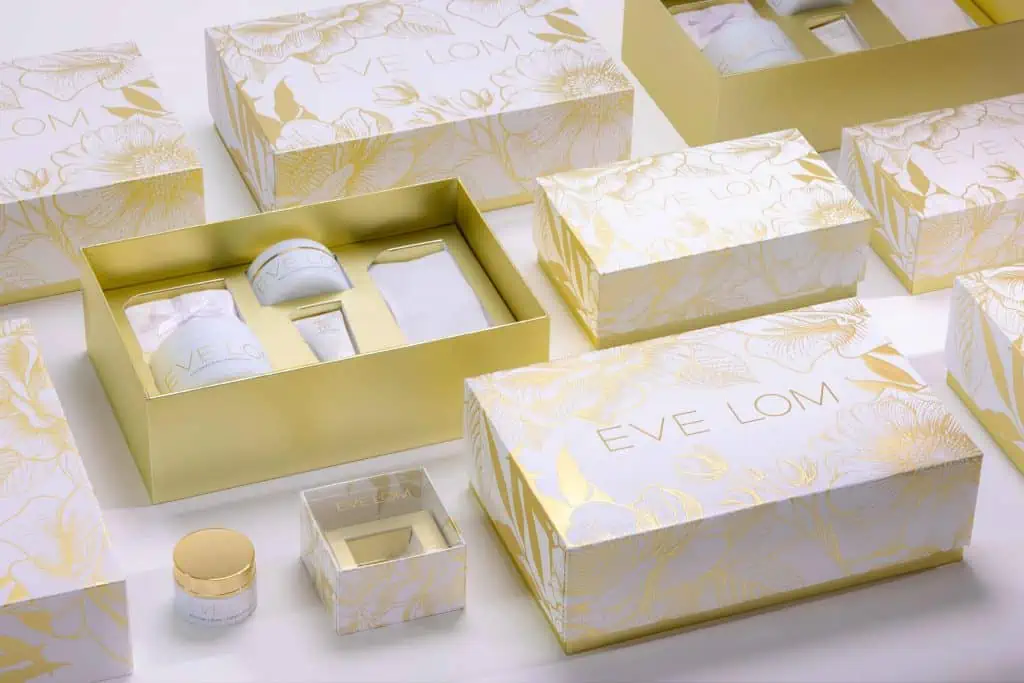
Most indie skincare founders get packaging wrong in the same direction. They spend heavily on formulation, which is right, and then treat packaging as an afterthought, which costs them significantly in sales. The result is a product that performs well but loses at the shelf to brands with comparable formulas and better boxes.
Luxury skincare packaging does not require the budgets of Chanel or La Mer. It requires understanding which design and material choices create the perception of premium quality at retail and which add cost without adding that perception.
What Makes Packaging Look Luxury: The Functional Principles
Weight and Structural Rigidity
Customers assess product quality through touch before they read a word on the label. A box that feels substantial, thick board, clean score lines, tight fold registration, creates an immediate quality impression.
A box that flexes under light hand pressure communicates cheapness regardless of what the label says. Specifying 380 to 420 GSM board rather than the thinner 300 GSM standard is one of the most cost-effective upgrades available.
Matte Surfaces
Matte lamination or matte aqueous coating is the dominant surface treatment in luxury skincare packaging for a reason. Gloss packaging reads as mainstream and mass-market. Matte reads as considered, premium, and modern. For a brand entering a competitive skincare category, switching from gloss to matte finish is frequently the change that moves the brand from looking like a drugstore product to looking like a boutique one.
Tight Tolerances and Clean Registration
The gap between a panel and the print edge, the precision of a fold, the alignment of a foil stamp, these details are invisible when done correctly and immediately apparent when done poorly. Supplier selection matters here more than budget. A lower-cost supplier who cannot hold tight tolerances will produce packaging that looks cheap regardless of material specification.
Finishing Techniques That Punch Above Their Price Point
Embossing Without Ink
A blind emboss, a raised relief in the board with no ink or foil, is one of the most sophisticated effects available in commercial packaging. Applied to a logo or decorative border, it communicates craft and attention to detail that printed flat finishes cannot replicate. On a matte white or matte cream board, a blind-embossed logo reads as genuinely premium. The technique adds $0.04 to $0.09 per unit at 1,000-unit run sizes.
Single-Colour Foil Stamp
Gold foil on white matte board is perhaps the most reliable visual shorthand for luxury in the skincare category. For a brand that cannot afford full-colour printing plus foil across an entire box, applying foil to the logo or brand name only, with the rest of the box in a single flat colour or plain white, is more impactful than full-colour printing without any foil.
Spot UV on Key Graphic Elements
Selective spot UV coating on a logo or product name creates a tactile dimension that customers notice. The effect is subtle in photographs but immediate in person, making it particularly valuable for products sold in physical retail environments.
Structural Choices That Signal Premium Quality
Two-Piece Setup Boxes
A base and lid structure is the quintessential luxury packaging format in skincare. The lid lifts from the base with a satisfying resistance, the result of precise dimensional tolerances, that creates an immediate premium impression. For hero products or gift SKUs, the cost increase over folding cartons is justified by the purchase experience they create.
Folding Carton with Magnetic Closure
Magnetic closure folding cartons combine the economics of folding carton construction with the premium unboxing experience of a magnetic seal. This format has become strongly associated with premium skincare and beauty over the past five years and reads as expensive to most consumers regardless of the underlying unit cost.
Typography and Colour in Luxury Skincare Packaging
Luxury skincare packaging almost always uses a restricted colour palette and significant negative space. Products that use four or five colours in a busy composition look busy; products that use one or two colours with deliberate spacing look refined.
Typography choices should prioritise elegant serif or refined sans-serif typefaces at generous leading. Track slightly wider than the default setting of most design software reads as premium in personal care packaging. Set your product name at minimum 24 points on the primary display panel.
The Photography Investment That Completes the Picture
Packaging design and product photography are inseparable for DTC and social-commerce skincare brands. Luxury skincare packaging that is photographed poorly looks average. The same packaging photographed with deliberate attention to lighting, texture, and prop selection can look like a $60 product regardless of retail price.
A half-day photography session with a product photographer experienced in skincare and beauty can be done for $400 to $800 and produces assets that serve the brand for 12 to 18 months. Bad photography of good packaging suppresses conversion rates on every channel it appears. Good photography multiplies the value of the packaging investment.
 synaworld43
  Lavishcars